
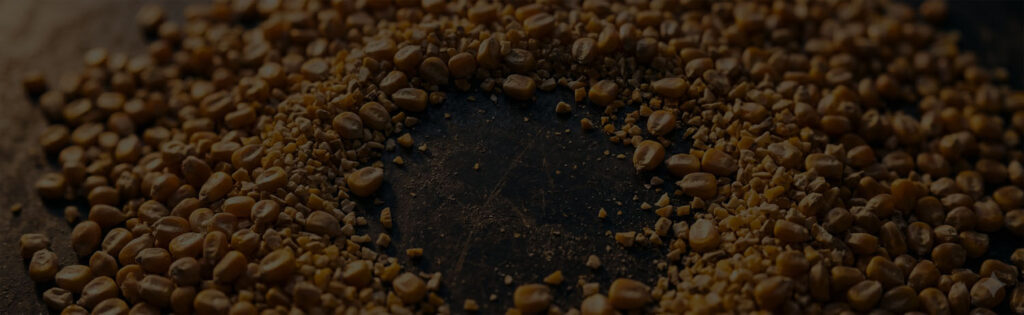
How Corn Characteristics Determine Machine Type
The three primary corn products that pass through bagging machines have fundamentally different flow properties:
| Product | Particle Size | Bulk Density | Flow Class | Recommended Fill Mechanism |
|---|---|---|---|---|
| Whole kernel corn | 6–12 mm | 720–760 kg/m³ | Free-flowing | Gravity gate or belt feeder |
| Corn grits (coarse) | 1–4 mm | 650–700 kg/m³ | Free-flowing | Gravity gate or vibratory feeder |
| Corn meal / corn flour | 0.1–0.5 mm | 400–550 kg/m³ | Cohesive, aeration-prone | Screw (auger) feeder with agitator |
The bulk density gap between whole kernel (760 kg/m³) and corn meal (450 kg/m³) is significant. A machine set up with a gravity gate optimised for whole kernel will underfill corn meal by 10–15% if the gate timing is not recalibrated — and even then, the aeration behaviour of fine meal means fill accuracy on a volumetric system will drift throughout the shift as the product settles in the hopper.
Bag Types and Fill Head Compatibility
Corn is packaged across a wide range of bag formats depending on the market: retail (1–5 kg polypropylene or kraft bags), food service (25 kg woven PP), and export bulk (50 kg woven PP or 500–1,000 kg FIBC). The fill head configuration must match the bag type — for FIBC fills above 500 kg, separate equipment and specification criteria apply.
Valve bags
used for corn meal and flour where dust control matters; the fill spout inserts into a pre-formed valve; self-sealing after spout withdrawal. Fast cycle time (4–8 seconds for 25 kg), but bag changeover requires a specific valve size match to the fill spout diameter.
Open-mouth woven PP bags
the most common format for 25–50 kg corn grain and grits; requires a bag clamp and stitcher or heat sealer at the discharge end. More forgiving of bag supplier variation than valve bags.
Retail form-fill-seal
1–5 kg retail packs; requires a vertical form-fill-seal (VFFS) machine, which is a separate equipment category from the bagging scales described in this guide.
Throughput Benchmarks for Corn Bagging Lines
Expected throughput for a net-weight corn bagging machine under stable production conditions:
| Fill Weight | Product | Bags/Hour (single head) | Bags/Hour (dual head) |
|---|---|---|---|
| 25 kg | Whole kernel corn | 360–480 | 700–900 |
| 25 kg | Corn grits | 300–420 | 600–800 |
| 25 kg | Corn meal | 200–300 | 400–580 |
| 50 kg | Whole kernel corn | 180–240 | 350–460 |
Corn meal throughput is lower because the fine product requires a slower coarse-to-fine transition to maintain fill accuracy. Running corn meal at the same gate speed as whole kernel produces fill variation of ±2–4% — acceptable for animal feed, not acceptable for retail or export declared-weight bags.
Accuracy Requirements by Market
Fill accuracy requirements differ significantly between end markets for corn products:
Retail and food service (declared weight): Most jurisdictions require the average fill weight to meet or exceed the declared weight, with no more than a defined percentage of bags below a lower tolerance limit. In the EU, this falls under the Weights and Measures directive; in the US, under NIST Handbook 133. A ±0.2% fill accuracy system on a 25 kg bag means ±50 g — well within legal tolerances.
Animal feed and industrial bulk: Less stringent in practice; ±0.5% is routinely accepted. The focus shifts from per-bag accuracy to batch-total accuracy — customers verify total pallet weight rather than individual bags.
Export (by container): Container weight limits (typically 27.5 tonnes payload for a 20-foot container) mean that consistent overfill on 25 kg bags adds up. A consistent +50 g per bag on a 1,100-bag container adds 55 kg — negligible on its own, but if your machine drifts to +200 g per bag, you are giving away 220 kg per container undetected.
Maintenance Points Specific to Corn Products
Corn dust — particularly from corn meal and dry grits — is combustible. In the EU, corn dust at concentrations above 60 g/m³ is classified as an explosive atmosphere (ATEX Zone 22 during normal operation). This has direct implications for machine specification:
- Electrical components inside dust-exposed areas must be rated IP54 minimum; ATEX-rated components required in Zone 22 areas; all product-contact surfaces should be food-grade stainless steel
- Dust collection at the fill spout is not optional in enclosed environments — it is a fire and regulatory requirement
- Grounding and bonding of all metal components is mandatory to prevent static build-up; corn dust static ignition events are documented in grain handling facilities
On the mechanical side: whole kernel corn is abrasive enough to wear uncoated mild steel feed gates within 18–24 months of continuous operation. Stainless steel or hardened wear liners on the gate contact surfaces extend service life to 4–6 years. We include hardened wear liners as standard on our corn bagging machines — not every supplier does, so confirm this before you order.
Frequently Asked Questions
Can one corn bagging machine handle both 25 kg and 50 kg bags?
Yes, with a programmable controller and adjustable bag clamp. The machine needs a product preset for each fill weight, and the bag clamp throat size must accommodate both bag widths. Our corn bagging machines support 4–16 product presets with no tooling change required — only a controller adjustment between bags. The practical limitation is cycle time: a 50 kg fill at the same flow rate takes twice as long, which cuts throughput roughly in half.
Is a separate checkweigher needed on a corn bagging line?
For retail and export declared-weight applications: yes. The bagging machine controls fill weight, but a downstream checkweigher catches mechanical failures — a jammed gate that causes an underfill, or a bag that partially filled before the clamp released. Running without a checkweigher means underfill bags reach the customer undetected. For animal feed bulk applications where the tolerance is wider, an inline checkweigher is less critical.
What is the difference between a corn bagging machine and a grain bagging machine?
No meaningful difference in machine type — a grain bagging machine designed for wheat or rice will handle whole kernel corn without modification, since the bulk density and particle size ranges overlap. The application-specific label reflects the sales category, not a different machine architecture. Where product-specific design does matter is at the extremes: a corn meal bagging machine requires a screw-feed mechanism that a pure gravity corn kernel bagging machine does not. We configure our machines for the most demanding product in the range — for a mixed corn line, that means screw-feed with auger for meal, switchable to gravity gate for whole kernel runs.