
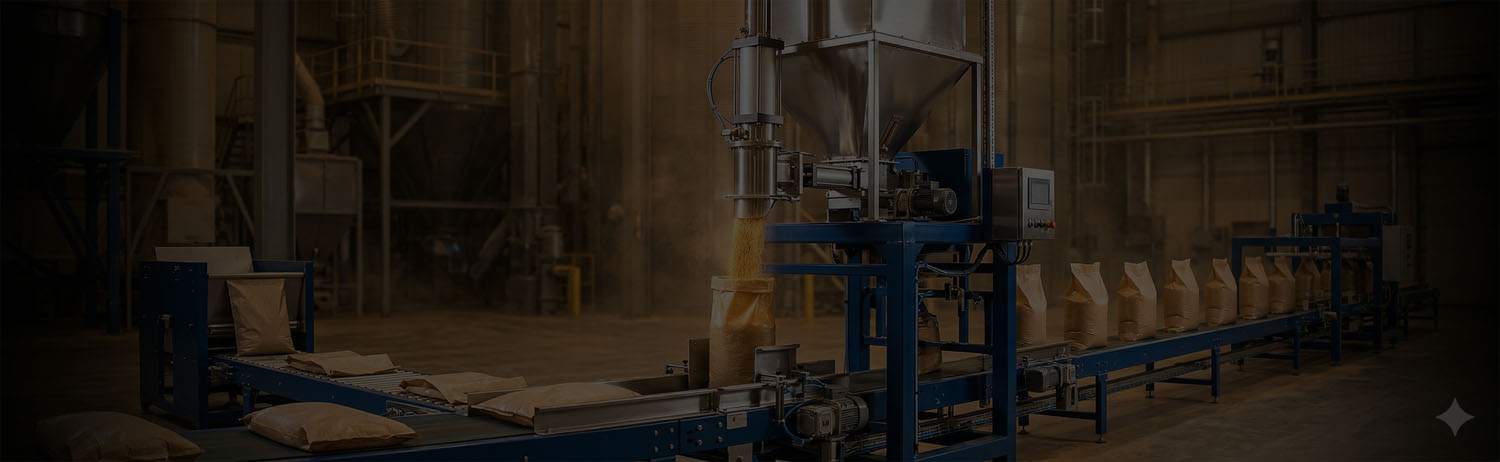
Grain Bagging Machine Types
Grain bagging system selection depends primarily on required throughput, compliance requirements (legal-for-trade weight), and whether you are running multiple grain varieties with different densities.
Automatic Net Weight Grain Bagger
Net Weight — Multi-Grain
The most requested system for grain facilities running multiple varieties — wheat, corn, soybeans, or rice on the same line. Each grain has a different bulk density (wheat ~780 kg/m³, corn ~720 kg/m³, soybeans ~770 kg/m³, long-grain rice ~680 kg/m³) and a volumetric system will give different actual weights for each variety unless manually recalibrated at each changeover. A net weight system with PLC recipes eliminates this entirely — recipe change at the HMI, no mechanical adjustment.
At production scale across 30 consecutive bags of mixed-grain operations, we consistently see ±0.3–0.5% accuracy — well inside the tolerances required by EU Directive 2014/31/EU on non-automatic weighing instruments and the OIML R87 standard on net quantity of products in packages.
- Bag weight:10 kg – 50 kg
- Speed:10–16 bags/min
- Accuracy:±0.3–0.5%
- Recipes:Up to 50 grain varieties stored
- Compliance:Per-bag weight log (CSV) standard
Volumetric Gravity Gate Grain Bagger
Volumetric — High Speed
For single-grain operations (e.g. a rice mill packing only one variety) where bulk density is highly consistent and speed is the priority. Gravity gate volumetric fillers have fewer moving parts than net weight systems and can run faster — up to 20 bags/min single-spout. Accuracy is ±1–2%; recalibration required when switching grain varieties or moisture content changes seasonally.
- Bag weight:10 kg – 50 kg
- Speed:Up to 20 bags/min
- Accuracy:±1–2%
- Best for:Single variety, consistent moisture
Dual-Spout High-Speed Grain Bagger
Dual Spout
Two independent net weight spouts on a shared hopper frame for operations needing 18–28 bags per minute at 25 kg. Each spout has its own load cell and fill valve — one spout can be serviced while the other continues at 50% line capacity. The dual-needle stitcher required to match this throughput is specified and costed as part of the system quote.
- Bag weight:10 kg – 50 kg
- Speed:18–28 bags/min
- Spouts:2 independent load cells
- Stitcher:Dual-needle or twin-lane
Retail Grain Pack Machine (1–10 kg)
Small Pack
Vertical form-fill-seal or semi-automatic open-mouth filler for retail rice, flour, and specialty grain packs in 1 kg, 2 kg, and 5 kg sizes. VFFS for high-volume production of uniform packs; semi-auto open-mouth for lower volumes with multiple SKUs. Food-grade contact materials, printable bag options.
- Pack weight:500 g – 10 kg
- Speed (VFFS):20–80 packs/min
- Bag types:PP, laminate, kraft-PE
- Best for:Retail rice, specialty grains, export packs
Fully Automatic with Bag Placer
With Auto Bag Placer
Bag magazine, vacuum bag presenter, fill, stitch, and conveyor integration in a single line. One operator monitors the full system; no manual bag placement. For operations running more than one shift per day, the labour saving vs a semi-automatic line typically pays back the bag placer cost within 6 months. Bag magazine capacity: 200–400 bags.
- Bag weight:10 kg – 50 kg
- Speed:8–14 bags/min (single-spout)
- Operators:1 monitoring (no manual bag placement)
- Magazine:200–400 bags per load
Semi-Automatic Grain Bagger
Semi-Automatic
Manual bag placement on fill spout, foot-pedal trigger, gravity or net weight fill. Suitable for small mills, farm stores, and cooperatives processing under 3,000 bags per month. Capital cost $4,000–$9,000 — the automation economics don’t favour automatic systems at this production volume unless labour cost is high.
- Bag weight:10 kg – 50 kg
- Speed:2–5 bags/min (operator)
- Price range:$4,000–$9,000
- Best for:Small mills, cooperatives, farm stores
How a Net Weight Grain Bagging Line Works
1. Grain Feed & Surge Hopper
Grain enters a surge hopper above the fill head from a bucket elevator, gravity bin, or conveyor. The surge hopper maintains a constant fill head pressure — consistent head pressure is what keeps fill cycle times uniform. Hoppers sized too small refill mid-cycle and cause fill-time variation that increases weight spread.
2. Bag Placement & Clamping
Bag is presented on the fill spout (manual or automatic placer). Pneumatic clamps close. For PP woven grain bags, clamp pressure is moderate — grain bags typically have heavier weave than feed bags and handle clamping without tearing. The bag bottom should be at least 200 mm above the floor to allow the load cell to read tare without floor-contact interference.
3. Coarse + Fine Fill
Coarse gate opens — grain flows at full rate. At ~88% of target weight, the fine gate takes over at ~15% of coarse flow rate. Load cell triggers cut-off when net weight is reached. In-flight correction factor (grain in freefall between valve and bag at cut-off) is calibrated per grain type and adjusts automatically via the PLC recipe.
4. Fold, Stitch & Convey
Bag clamp releases. Bag passes to a top-folder that makes a uniform 2–3 fold closure, then to the stitcher. Stitch quality matters for grain bags that are handled roughly in transit — a broken stitch on a 50 kg wheat bag is not a minor problem. We specify the stitcher needle and thread combination for your bag material and specify a minimum stitch tension test in the commissioning checklist.
A grain export operation in Ukraine enquired about upgrading from manual to automatic bagging at 25 kg wheat. Their manual throughput was 7–8 bags per minute with 3 operators. The automatic single-spout net weight line we quoted ran 12–13 bags per minute with 1 operator monitoring — a 60–70% output increase alongside a 2-operator reduction. At first commissioning, the line ran 9 bags per minute. The cause: the stitcher was a standard single-needle unit that topped out at 11 bags per minute under continuous operation — fine on spec but a constraint in practice. We replaced it with a dual-needle stitcher during commissioning and reached 13 bags per minute by end of day. The lesson: the stitcher speed should be specified with 20–30% headroom above the target fill rate, not matched exactly.
Applications by Grain Type
Wheat & Barley
Whole, cleaned wheat and barley in 25–50 kg PP woven sacks for milling and animal feed markets. Bulk density 770–800 kg/m³, stable between harvests. High throughput is the priority at most milling facilities — dual-spout net weight systems at 20–26 bags per minute are common specifications.
Corn / Maize
Whole corn, cracked corn, and corn meal in 25–50 kg bags — each form has different fill mechanism requirements; for a detailed breakdown see our corn bagging machine application guide. Whole corn is abrasive — fill spout wear rate is 2–3× higher than soft grain. Hardened steel or ceramic-lined contact spout sections are specified as standard. Cracked corn is dustier and may require a hood extraction upgrade.
Rice (Paddy & Milled)
Long-grain and short-grain milled rice in 5–50 kg bags. Paddy (unhusked) is bulkier and more abrasive than milled rice. Retail rice in 1–5 kg bags is typically packed on VFFS lines with printed laminate film. Export rice in 25–50 kg PP woven sacks uses standard open-mouth net weight systems.
Soybeans & Sunflower
Whole soybeans and sunflower seeds for oil pressing input and direct feed markets. These are oilseed crops — oil coating on the seeds slightly reduces spout friction vs dry grain, which can increase fill speed but also increases slip on conveyors. Anti-static bag clamp materials are specified for high-oil-content oilseeds.
Dried Pulses (Lentils, Chickpeas, Peas)
Whole and split dried legumes for food and feed markets. Chickpeas and whole lentils fill well with standard gravity gate systems. Split pulses (split red lentils, yellow peas) have irregular shapes that increase bridging risk in hopper corners — active hopper agitation is specified for high-split-fraction products.
Specialty & Heritage Grains
Quinoa, amaranth, teff, farro, and specialty milling grains for premium food markets. Smaller production volumes — semi-automatic systems are often the right starting point. Packaging format (kraft paper bags, retail-ready design) matters as much as fill speed in this segment. Food-grade contact materials and allergen-separation cleanout ports are specified.
Net Weight vs Volumetric for Grain
| Factor | Volumetric (Gravity Gate) | Net Weight (Load Cell) |
|---|---|---|
| Accuracy — single grain variety | ±1–2% | ±0.3–0.5% |
| Multi-variety changeover | Manual recalibration required (10–20 min) | PLC recipe switch — under 2 min |
| Seasonal moisture variation compensation | None — recalibration required | Automatic — weight-based, not volume-based |
| Legal-for-trade compliance record | Not standard | Per-bag weight log standard |
| Speed (single-spout auto) | Up to 20 bags/min | 10–16 bags/min |
| Capital cost (single-spout auto) | Lower ($8,000–$16,000) | Higher ($18,000–$32,000) |
| Overfill cost at 1% avg, $0.35/kg grain, 50,000 bags/month (25 kg) | $4,375/month | $1,093/month (0.25% avg) |
Overfill cost baseline: 50,000 bags × 25 kg × $0.35/kg × overfill %. Net weight ROI above is based on overfill saving alone. At this production volume and grain value, payback on the incremental net weight cost is typically 14–20 months — faster if you are switching grain varieties frequently.
Why Grain Mills Choose QingXin Machinery
Stitcher Speed Matched to Filler Speed
Most line speed shortfalls on grain bagging installations we diagnose are stitcher constraints, not filler limitations. Standard single-needle stitchers top out at 11–13 bags per minute in continuous operation — fine for lines targeting 10 bags per minute, a bottleneck for anything higher. We specify the stitcher for 20–25% headroom above target fill rate and include a stitcher speed test in the pre-shipment validation report. If the stitcher can’t keep pace, we resolve it before the line leaves our facility.
Multi-Variety Recipe Management
Grain facilities often run 3–10 different varieties on the same line across a season. Each variety has a slightly different bulk density, and seasonal moisture variation changes density further. Our PLC recipe system stores separate fill parameters for each product: coarse/fine switchpoint, in-flight correction factor, and de-aeration setting. Recipe changeover takes under 2 minutes. Buyers who are currently doing manual recalibration between varieties tell us they recover 30–60 minutes of productive time per shift after switching to recipe-based management.
Hopper Sizing and Bridging Prevention
We size the surge hopper to maintain consistent fill head pressure at maximum rated throughput — not to the minimum volume that fits in the available space. Undersized hoppers need to refill mid-cycle, causing fill cycle time variation that widens the fill weight distribution. For sticky or high-moisture grain, we add an active agitator to the hopper. The agitator specification is based on product moisture content and particle size at time of filling, not a generic recommendation.
Pre-Shipment Validation at Your Grain Density
Our speed and accuracy tests before shipment use a reference grain product (typically wheat or corn). If you are packing a different variety or a specialty grain with an atypical bulk density, we ask for a product sample and run the validation with your actual grain. The test report you receive reflects your product performance, not a generic published figure. This is especially relevant for oilseeds and specialty grains where bulk density can be 10–15% lower than standard cereals.
Technical Specifications
| Parameter | Semi-Auto | Automatic Single-Spout | Automatic Dual-Spout |
|---|---|---|---|
| Bag weight range | 5 kg – 50 kg | 10 kg – 50 kg | 10 kg – 50 kg |
| Fill accuracy | ±1–3% | ±0.3–0.5% | ±0.3–0.5% |
| Speed (25 kg wheat) | 2–5 bags/min | 10–16 bags/min | 18–28 bags/min |
| Fill principle | Gravity or net weight | Net weight (load cell) | Net weight (dual load cell) |
| PLC product recipes | None | Up to 50 recipes | Up to 50 recipes |
| Bag types | PP woven, paper | PP woven, paper, PE, laminated | PP woven, paper, PE, laminated |
| Sealing | Manual stitcher | Single or dual-needle stitcher | Dual-needle stitcher standard |
| Fill weight data log | No | Per-bag CSV log | Per-bag CSV log (per spout) |
| Hopper agitation | Passive | Active (for moisture >14%) | Active standard |
| Power supply | 220V 50/60Hz | 380V 3-phase 50Hz | 380V 3-phase 50Hz |
| Lead time | 10–15 days | 18–25 days | 22–30 days |
Related Packaging Equipment
Automatic Bagging Machine
For grain export operations requiring 500–2,000 kg FIBC bags rather than 25–50 kg sacks, see our bulk bag filling machine guide — the filling principle and accuracy specs differ significantly from standard grain baggers.
General-purpose bagging systems for grains, powders, and free-flowing materials at high speed.
Flour Bagging Machine
Specialised systems for milled flour with fine-powder handling, de-dusting, and accurate net weight filling.
Animal Feed Bagging Machine
Bagging systems for grain-based feeds including de-aeration for pellets and high-void-ratio products.
Automatic Packaging Line
Complete grain packaging lines integrating filling, sealing, checkweighing, and palletising.
Frequently Asked Questions
What grain products can this machine pack?
Our grain bagging machines handle wheat, corn, rice, soybeans, barley, sorghum, sunflower seeds, and dried pulses (peas, lentils, chickpeas). The main handling variations are moisture content, particle size, and abrasiveness. We ask for your specific grain type before specifying the spout material and hopper agitation configuration.
How fast can a grain bagging machine fill bags?
Automatic single-spout net weight: 10–16 bags per minute at 25 kg. Dual-spout: 18–28 bags per minute. Volumetric gravity gate: up to 20 bags per minute single-spout. The bottleneck on high-speed grain lines is usually the bag stitcher, not the filler — standard single-needle stitchers top out at 11–13 bags per minute. We specify stitcher speed with 20–25% headroom above target fill rate.
Is net weight filling necessary for grain?
Grain has stable bulk density when dry and uniform, making volumetric feasible for single-variety operations. However, multi-variety lines and legal-for-trade compliance typically require net weight filling. For operations switching between wheat, corn, soybeans, and rice on the same line, a PLC recipe-based net weight system eliminates the manual recalibration required at each variety changeover.
What bag types are used for grain?
PP woven sacks (25–50 kg) are the dominant format globally — cost-effective, moisture-resistant, and suitable for machine filling and stitching. Kraft paper bags are used in premium retail grain markets. Laminated PP or PE-coated bags are specified for export grain requiring moisture barrier protection. Jute bags remain in some traditional markets but require manual bag placement on most automatic systems.
How do I handle grain with high moisture content?
Grain above 14–15% moisture becomes tacky and tends to bridge in standard gravity hoppers. The mechanical solution is an active hopper agitation system. For grain above 16%, we strongly recommend addressing moisture content upstream (dryer or conditioning) before bagging — a bagging machine that runs well at 12% moisture will have serious productivity problems at 18% regardless of agitation.
What is the ROI on automating grain bagging?
Manual grain bagging at 25 kg requires 2–3 operators to sustain 6–8 bags per minute. That is $8,000–$16,000 per month in direct labour at $20/hr for one shift. An automatic net weight line at $22,000–$35,000 installed typically recovers labour cost within 3–6 months on single-shift operations. Fill accuracy improvement adds a secondary return: a 1% reduction in overfill at $0.35/kg grain and 50,000 bags per month is worth over $4,000 per month additionally.
Can the machine handle multiple grain varieties?
Yes. With a PLC recipe system, each grain variety has stored parameters for fill weight set-point, coarse/fine flow switchpoint, and in-flight correction factor. Recipe changeover takes under 2 minutes. Physical cleaning between varieties (allergen or cross-contamination requirement) takes 10–15 minutes via a bottom cleanout port in the hopper. We design the cleanout port into every grain bagging system as standard.
What Buyers Say After 12 Months on the Line
Real feedback from three production environments — grain, chemical powder, and cement.
We had specified a machine from another supplier based on a PDF quotation. QingXin’s engineer came back and said the auger pitch wasn’t right for our product bulk density and suggested a different filling head. That kind of pushback was unexpected — and correct.
The chemical powder we pack has variable bulk density depending on batch temperature. I was told by two other suppliers this was ‘not a problem’ without testing. QingXin ran a sample test and recommended a different hopper agitator. 18 months in, the machine has not had a single blockage.
We run the cement packer on two shifts, six days a week. The hardened impeller wear liners lasted 14 months before first replacement — the previous machine needed replacement every 4 months. Maintenance cost in year one was 60% lower than the machine we replaced.
Further Reading
Request a Factory Direct Quote
CE-certified machines, factory pricing, 48-hour quote turnaround.