
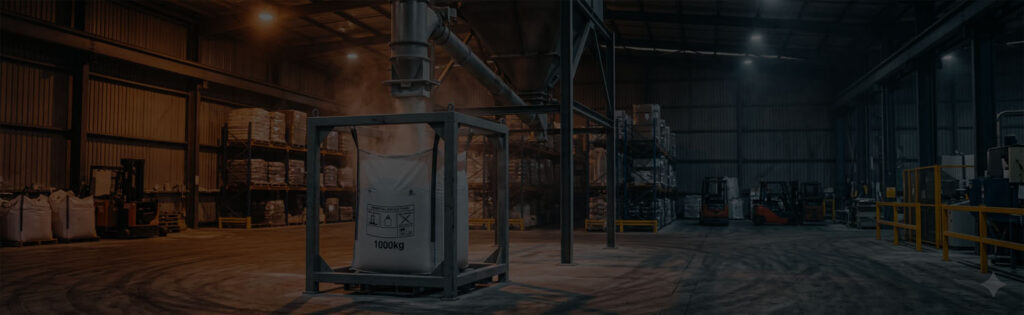
How a Bulk Bag Filling Machine Works
A bulk bag filling machine — also called a FIBC filling machine or big bag filler — operates on a gravimetric fill principle: the bag is suspended or supported on a load cell frame, and filling stops when the target weight is reached. This is different from volumetric filling (auger or impeller systems), which measure fill volume rather than mass. For bulk bags, gravimetric control is the standard because bag capacity varies and product bulk density fluctuates between batches.
A standard fill cycle on a semi-automatic bulk bag filling machine runs as follows:
- Empty bag placed on hooks or frame — the operator positions the bag on four loop hooks or a pallet support frame; the spout is connected to the fill head
- Bag inflation — an inflator fan fills the bag with air before product entry, opening the bag structure and preventing wall collapse during filling
- Coarse fill — product enters at high flow rate until approximately 90% of target weight
- Fine fill — flow rate reduces to prevent overshoot; the load cell reading updates at 10–50 Hz depending on controller specification
- Fill complete, spout released — the fill head retracts; the operator or automated conveyor removes the filled bag
- Densification (optional) — a vibrating pallet or bag massager compacts the product to reduce headspace; important for powders that aerate during filling
Cycle time on a single-spout bulk bag filler ranges from 2 to 6 minutes per bag depending on fill weight (500–2,000 kg typical), product flow rate, and whether densification is included. A dual-spout rotary system can reach 4–8 bags per hour per station on a shared conveyor.
FIBC Types and How They Affect Machine Selection
There are four common FIBC construction types. Each affects the fill head design and machine geometry in ways that are not interchangeable without modification.
| Bag Type | Fill Spout | Loop Configuration | Machine Consideration |
|---|---|---|---|
| Standard 4-loop | Top fill spout, drawstring closure | 4 corner loops on horizontal bar | Most common; requires hook height adjustment for different bag sizes |
| Circular woven / tubular | Top fill spout | 4 loops or 2-loop sling | Less rigid wall; requires bag inflation before filling to prevent collapse |
| Liner bag | Fill spout on liner, not outer bag | Standard 4-loop | Liner inflation and spout sealing require dedicated clamp; volatile or food-grade products |
| Form-fill-seal (FFS) bulk | Machine-formed from film roll | No loops; pallet support | Requires FFS bulk packing machine — different machine category entirely |
The liner bag variant deserves specific attention. If your product is hygroscopic, reactive to moisture, or food-grade, you will likely need a liner. The liner spout is a smaller diameter than the outer bag spout, and the fill head clamp must match the liner spout — not the outer bag. We match the fill head clamp to the liner spout specification on every liner-bag system we supply — a standard fill head on a liner bag application causes product contamination or seal failure on the first production run.
Accuracy: What the Specifications Actually Mean
Bulk bag filling machine accuracy is quoted as ±X kg or ±X% of fill weight. The honest answer on what this means in practice: the quoted figure is the mechanical repeatability under stable conditions. Real production accuracy is also affected by:
Product bulk density variation
if your material arrives at 600 kg/m³ in winter and 520 kg/m³ in summer (due to moisture), the fill volume changes even if weight control is perfect
Densification settling
if you weigh after densification, the settled weight will be 1–3% lower than the pre-densification reading for fine powders
Vibration from nearby equipment
conveyors, compressors and forklifts within 3 metres of the load cell frame cause reading noise; isolation mounts reduce this by 60–70%
Spout seal integrity
a loose spout clamp allows dust leakage and air ingress, both of which corrupt the in-flight load cell reading
The single-spout bulk bag fillers we supply achieve ±0.1–0.2% of target weight under stable production conditions. On a 1,000 kg fill, that is ±1–2 kg — well within legal trade limits in most markets. A poorly installed system in a high-vibration environment can drift to ±5–8 kg even with a high-specification load cell.
Four Numbers to Confirm Before Specifying a Machine
These four parameters determine machine frame height, fill head design, conveyor specification, and motor sizing. Collect them before requesting a quote.
Filled bag dimensions (L × W × H)
determines frame footprint and hook height range; most adjustable-frame fillers cover 900–1,200 mm bag height without modification
Fill weight range
single-range machines (e.g., always 1,000 kg) can be calibrated tighter; wide-range applications (500–2,000 kg on the same line) need a controller with multiple product presets
Product bulk density and flow class
free-flowing granule vs. cohesive powder vs. aerated fine powder each requires a different feed gate and flow control mechanism
Required throughput (bags/hour)
this determines whether a single-spout manual system, a semi-automatic with pallet conveyor, or a fully automatic rotary system is the economic choice; the crossover point where automation pays back is typically above 15 bags/hour on two-shift operation
Where Bulk Bag Filling Machines Fail in Service
Three failure modes account for the majority of service calls on bulk bag filling equipment:
Load cell drift. Load cells on the fill frame are exposed to product dust, moisture and mechanical shock from forklift contact. Drift of 2–5 kg over 6 months is common without calibration. Schedule a dead-weight calibration check every 90 days. We include a calibration weight with every bulk bag filling machine we ship — a 100 kg or 200 kg reference weight left near the frame lets operators verify zero-point and span without calling a technician.
Bag hook wear and deformation. On machines running abrasive or heavy products, the loop hooks deform over 12–18 months under repeated 1,000+ kg loads. Deformed hooks cause bags to hang off-centre, which shifts the load cell reading and causes one-sided bag overfill. Inspect hook geometry quarterly.
Fill head gasket failure. The rubber gasket between the fill head and bag spout compresses with every cycle. On high-cycle machines (60+ bags per shift), gasket replacement is a 6-month maintenance item, not a 3-year item. Running a worn gasket on a dust-controlled product (cement, chemical powder) generates enough fugitive dust to trigger regulatory action in some jurisdictions.
Bulk Bag Filler vs. Open-Mouth Bag Filler: Which Application Belongs Where
The decision between a bulk bag (FIBC) system and a smaller open-mouth bag system is not primarily about preference — it is about downstream logistics. Bulk bags (500–2,000 kg) reduce handling cost per tonne significantly but require a forklift or crane at both the fill point and the discharge point. If your customer does not have the unloading equipment for a 1,000 kg bag, a bulk bag system creates a problem you are shipping to them. If the smaller bag format is the right fit, our bagging machine buyer’s guide covers fill mechanism selection and accuracy specification for 5–50 kg formats.
The economic tipping point for bulk bag filling is typically above 20 tonnes per day of outbound product. Below that volume, the lower capital cost of a 25 kg open-mouth bag filling machine combined with palletising usually comes out ahead on total cost per tonne when you include the forklift operating cost. If you are at or above that threshold, our big bag filling machine guide covers automation levels, densification methods and load cell configuration in detail.
Frequently Asked Questions
What is the difference between a bulk bag filling machine and a big bag filling machine?
No functional difference — bulk bag filling machine, big bag filling machine, jumbo bag filler and super sack filler all refer to FIBC filling equipment. “Bulk bag” is more common in North American and European industrial contexts; “big bag” is the preferred term in Southeast Asian and Chinese markets. The bag itself (FIBC — Flexible Intermediate Bulk Container) is the same product regardless of regional naming convention.
Can a bulk bag filling machine handle both powder and granule products?
Yes, with the right feed mechanism. A gravity-fed system works for free-flowing granules; a screw or belt feeder is needed for cohesive powders that won’t gravity-discharge reliably. If your product range includes both, we offer interchangeable feed gate configurations on our bulk bag filling machines — the changeover typically takes 15–30 minutes. Trying to run a cohesive powder through a gravity-only fill head is the single most common source of underfill complaints on production lines.
Is CE certification required for bulk bag filling machines?
CE certification is required for equipment placed on the market in the EU and UK. It covers the mechanical safety of the machine, not the accuracy of the weighing system — the weighing accuracy falls under separate metrology regulations (OIML R 61 or EN 45501 depending on application). If your bags are sold by declared weight, the load cell and controller must meet the legal metrology standard, which is a separate certification from CE mechanical safety.
What throughput can I expect from a single-head bulk bag filler?
On a 1,000 kg fill with a free-flowing granule product and pallet conveyor assist: 6–8 bags per hour is realistic for a semi-automatic system. Fully automatic systems with automatic bag placement reach 10–15 bags per hour on the same fill weight. Fine powder products with densification add 1–2 minutes per cycle, reducing throughput by 20–30%.