
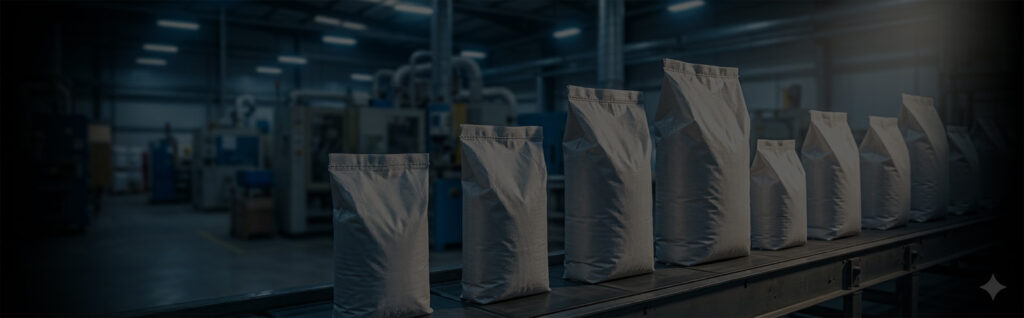
The most common cause of fertilizer packaging line downtime is not mechanical failure — it is moisture. Compound fertilizer absorbs ambient humidity and bridges inside hoppers within hours. The DCS-HF addresses this with a stainless steel frame, sealed hopper connections, and a −20 to +45°C operating range that keeps the line running through seasonal production surges in both tropical and cold-climate facilities.
Fertilizer Types the DCS-HF Handles
The DCS-HF is compatible with all major granular and powdered fertilizer products. The table below includes handling notes specific to each product type:
| Fertilizer Type | Bulk Density (kg/m³) | Key Handling Requirement | Compatible |
|---|---|---|---|
| Compound Fertilizer (NPK) | 900–1,100 | Moisture-tight bag sealing; PE inner liner | ✓ |
| Urea (granular / prilled) | 700–800 | Caking tendency — fast cycle time reduces exposure | ✓ |
| Ammonium Nitrate (AN) | 800–900 | Anti-static construction; ATEX option available | ✓ (ATEX opt.) |
| DAP / MAP | 850–1,050 | Corrosive; SS contact parts required | ✓ |
| Potassium Chloride (MOP) | 1,000–1,300 | High bulk density; oversized hopper recommended | ✓ |
| Potassium Sulphate (SOP) | 900–1,100 | Standard configuration | ✓ |
| Ammonium Sulphate | 750–900 | Fine crystal; TraxDSP interference protection | ✓ |
| Lime (hydrated) | 400–700 | Very fine powder; dust extraction recommended | ✓ |
| Sodium Chloride | 1,100–1,300 | High bulk density; oversized hopper gate | ✓ |
| Organic Fertilizer (granular) | 450–700 | Low density; adjust coarse fill gate opening | ✓ |
Note on urea: Urea above 65% RH ambient humidity begins to cake within 30–45 minutes in an open hopper. The DCS-HF handles this with a sealed hopper top and fast cycle time, but a dehumidified feed hopper is strongly recommended in tropical climates.
Why Fertilizer Bagging Needs a Dedicated Machine
A standard grain or food bagging machine used for fertilizer will fail within 6–18 months. These are the four failure modes and how the DCS-HF addresses each:
Corrosion (NPK, ammonium compounds)
Fertilizers contain ammonium, potassium and phosphate ions that corrode mild steel rapidly. DCS-HF uses a stainless steel frame and SS-coated contact surfaces throughout the weighing path.
Caking & Bridging (urea, AN)
Urea and ammonium nitrate form solid bridges in hoppers within hours of exposure to humidity. DCS-HF’s sealed hopper top and fast fill cycle minimize exposure time per batch.
Dust (lime, sulphate of potash)
Fine fertilizer dust is a respiratory hazard and damages electronic components. The DCS-HF uses sealed bearing housings and an optional dust extraction nozzle at the bag mouth.
Regulatory Accuracy (declared weight)
Fertilizer sold by weight is subject to weights-and-measures legislation in most markets. OIML Grade 0.2 accuracy ensures compliance at both 40 kg and 50 kg declared weights.
DCS-HF10 vs DCS-HF20: Which Model Do You Need?
The HF10 is sized for production volumes up to approximately 6 million bags per year. The HF20 doubles throughput and suits large compound fertilizer plants running two-shift operations year-round.
DCS-HF10 — Entry / Mid Volume
- 500–600 bags/hr (40–50 kg bags)
- ~4.8 million bags/year (2 shifts)
- Power: AC220V / 50Hz / 500W
- Accuracy Grade: 0.2
- Bag: PP woven + PE inner liner
- A/D conversion: 3,000:1
- RS232 communication interface
- TraxDSP anti-interference
- Weighing error display & correction
Best for: Regional fertilizer producers · Blending operations · Seasonal production lines
DCS-HF20 — High Volume
- 1,000–1,200 bags/hr (40–50 kg bags)
- ~9.6 million bags/year (2 shifts)
- Power: AC220V / 50Hz / 1,000W
- Accuracy Grade: 0.2
- Bag: PP woven + PE inner liner
- A/D conversion: 3,000:1
- RS232 communication interface
- TraxDSP anti-interference
- Dual-fill-head configuration
Best for: Large NPK plants · Export pack terminals · 3-shift operations
Complete Fertilizer Packaging Line Option
The DCS-HF scale can be integrated into a complete automated fertilizer packaging line, eliminating manual handling between the scale and the palletizer. A typical fertilizer line includes:
| Station | Component | Function |
|---|---|---|
| 1 | DCS-HF Packaging Scale | Net-weight filling at 1,000+ bags/hr |
| 2 | Automatic Bag Stitcher | Industrial GK-series sewing at line speed |
| 3 | Flat Belt Conveyor | Bag transport with orientation control |
| 4 | Bag Flattener | Compresses overfilled or irregular bags |
| 5 | CK Checkweigher | Rejects underweight/overweight bags automatically |
| 6 | Stacker & Palletizer | Layer stacking on standard 1,200×1,000 mm pallets |
See the Fully Automatic Packaging Line page for complete line specifications and industry-specific configurations. For export operations shipping in 500–1,000 kg FIBC bulk bags rather than 25–50 kg sacks, see our bulk bag filling machine guide — corrosion resistance and spout seal requirements differ from standard sack filling.
Planning Fertilizer Packaging Machine Output for Peak Season
Fertilizer production has sharper demand peaks than almost any other bulk product. Spring planting in the northern hemisphere creates a 4–6 week window where output must run at 2–3× the annual average rate. A fertilizer packaging machine sized for average throughput becomes the bottleneck during that window. We size for peak-season demand, not annual averages — the extra capacity costs less than one week of lost output per year.
Calculate Your Required Machine Speed
Use this method to confirm model selection before ordering:
- Total annual bags — divide annual production tonnage by bag weight. Example: 50,000 t/yr ÷ 50 kg/bag = 1,000,000 bags/yr
- Working hours — 2-shift × 250 days = 4,000 hrs/yr; single-shift = 2,000 hrs/yr
- Average rate needed — 1,000,000 ÷ 4,000 = 250 bags/hr (within DCS-HF10 range)
- Peak season check — if 40% of production falls in 8 weeks: 400,000 bags ÷ 320 hrs = 1,250 bags/hr — requires DCS-HF20 or dual-head configuration
Most regional blending operations fit the DCS-HF10. Fertilizer producers exporting above 150,000 t/yr or running 3-shift peak seasons typically need the HF20 or a dual-machine fertilizer packaging line. The calculation takes 5 minutes and we run it with every enquiry before quoting.
Switching Products Between Seasons
Between planting seasons, most fertilizer packaging machines run at 30–50% of rated speed to bag speciality products, micronutrients or soil conditioners in shorter runs. The DCS-HF stores 20 product recipes — weight target, fill speed, fine-fill cutover point — and switches between them in under 90 seconds. Operators select from the recipe list on the touchscreen; no mechanical adjustment needed between products.
If you bag both granular NPK (bulk density 900–1,100 kg/m³) and powdered lime (400–700 kg/m³) on the same fertilizer packaging machine: both are compatible, but the hopper gate opening needs a different setting for each. We configure both as named recipes at factory commissioning so the changeover is fully menu-driven.
Technical Specifications
| Parameter | DCS-HF10 | DCS-HF20 |
|---|---|---|
| Production Speed | 500–600 bags/hr | 1,000–1,200 bags/hr |
| Pack Weight | 40–50 kg/bag | 40–50 kg/bag |
| Accuracy Grade | 0.2 | 0.2 |
| Power Supply | AC220V / 50Hz / 500W | AC220V / 50Hz / 1,000W |
| Bag Material | PP woven with PE inner bag | |
| A/D Conversion | 3,000:1 | |
| Communication | RS232 (standard); RS485 option | |
| Controller | TraxDSP intelligent controller | |
| Frame Material | Stainless steel (contact surfaces) | |
| Operating Temperature | -20 to 45°C | |
| Max Humidity | 95% RH (non-condensing) | |
| Certification | CE, OIML Grade 0.2 | |
Frequently Asked Questions
Can one machine handle both NPK and urea without changing parts?
Yes. Product recipes are stored in the controller — switching between NPK and urea requires selecting the recipe, running 3–5 calibration bags and confirming weight. No mechanical changeover is needed if bag size remains the same. The sealed hopper design suits both products.
How does the scale maintain accuracy when bulk density varies between batches?
The DCS-HF uses TraxDSP automatic in-flight correction. After each bag is released, the controller measures the actual weight and adjusts the gate close-point for the next bag. This corrects for bulk density variations of up to ±15% without operator intervention. Beyond that range, a manual calibration run of 5 bags is recommended.
What anti-corrosion treatment is applied to contact parts?
All surfaces that contact fertilizer product are stainless steel (304 SS standard; 316 SS upgrade for DAP, MAP and ammonium compounds). The frame uses a powder-coated mild steel outer structure with SS inner lining. Load cells are hermetically sealed to IP67.
Is 1,000 bags per hour achievable at 50 kg per bag?
Yes, this is the rated output of the DCS-HF20 at 50 kg for granular compound fertilizer with a bulk density above 900 kg/m³. At lower bulk densities (organic fertilizer below 600 kg/m³), speed reduces to 800–900 bags/hr due to the longer fill time needed to reach target weight.
Is the DCS-HF suitable for ammonium nitrate packaging?
The standard DCS-HF is suitable for technical-grade AN not classified as an explosive. For AN fertilizer (ANFO blends or high AN content) classified under explosive regulations, an ATEX-rated version is required. Please specify this at enquiry stage.
What is the warranty period?
12 months from commissioning date, covering manufacturing defects. Load cells carry a separate 24-month warranty. Wear parts (bag mouth clamp rubber, gate seals) are consumables excluded from the warranty period.
View Full Product Specifications
Dimensional drawings, datasheet and detailed model documentation: