
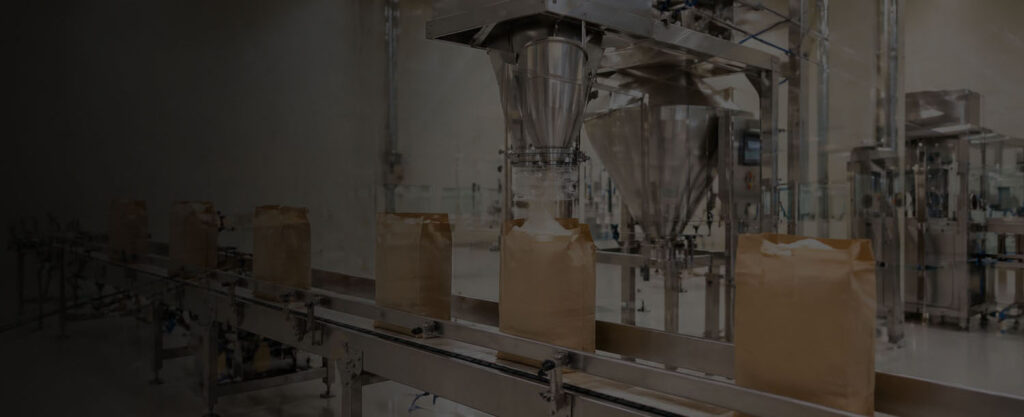
Why Flour Requires a Different Fill Mechanism
Wheat flour at typical mill output has a bulk density of 480–560 kg/m³ and a particle size of 80–150 microns. At those dimensions, flour particles stay airborne for several minutes after disturbance. The fill point — where flour enters the bag at high velocity — generates a dust cloud with every fill cycle unless the fill head includes positive dust control.
The two fill mechanisms used on flour packing machines are the auger (screw) filler and the impeller (centrifugal disc) filler:
| Mechanism | How it works | Flour suitability | Weakness |
|---|---|---|---|
| Auger (screw) filler | Rotating screw pushes flour downward through fill tube | Good for standard wheat flour; reliable fill accuracy at ±0.3–0.8% | Screw flights wear on fine abrasive flour; cohesive dough-grade flour can clump on flights |
| Impeller (disc) filler | Spinning disc fluidises and projects flour into bag | Excellent for low-density specialty flour (rice, coconut, almond); handles aerated product well | Less accurate than auger at ±0.5–1.5%; not suitable for coarse or dense flour |
| Net weight (gravimetric) | Load cell stops fill at target weight regardless of fill mechanism | Best accuracy for declared-weight flour packs; adds cost and reduces throughput slightly | Slower cycle time; requires more maintenance on the weighing system |
For a retail wheat flour line producing 1 kg and 2 kg bags at declared weight: a net-weight auger filler is the standard choice. For specialty flour (rice, almond, chickpea) in premium retail formats where accuracy tolerance is tighter: net-weight with an agitator in the hopper to prevent bridging.
Dust Control: What the Regulations Require and What Works in Practice
Wheat flour dust is explosive above a concentration of approximately 50 g/m³ (ATEX lower explosive limit). In an enclosed packaging room, a fill operation without dust extraction can reach this concentration during a bag change event or equipment jam. This is a safety requirement, not an optional feature.
Effective dust control on a flour packing machine requires three elements working together:
Sealed fill head with bag clamp
the fill spout seals against the bag opening before flour flow starts; this contains the initial dust burst that occurs when flour first enters the bag
Negative pressure at the fill point
a dust collector connected to the fill head creates negative pressure that draws any escaped flour back into the collection system rather than into the room atmosphere
Bag inflation before fill
inflating the bag with a small air volume before flour entry prevents wall collapse, which would otherwise push displaced air (and flour dust) out through any gap in the bag-to-spout seal
A flour packing machine without all three elements will generate visible dust at the fill point. In a food production environment, this is both a contamination risk and an explosion risk. The dust collector maintenance schedule — filter cleaning frequency, collection bin emptying — varies significantly between machine designs. We document this in our commissioning manual for every flour packing machine we ship; ask any supplier for this schedule before you buy.
Bag Types for Flour Packing
The three bag formats used for retail and food service flour each have different machine implications:
Paper bags (multi-wall). Standard format for 25 kg food service flour. Open-mouth fill with a heat-sealed or stitched top. Paper bags are susceptible to moisture damage — if the packaging room humidity exceeds 65% RH, paper bags may soften and lose structural integrity at the bottom seam during conveying. The packing room must be climate-controlled for paper bag lines in humid climates.
Woven PP bags with PE liner. Used for 25–50 kg commercial flour where moisture resistance matters more than presentation. The PE liner prevents moisture ingress; the woven PP provides structural strength. The fill spout must be sized for the liner opening, not the outer bag opening — a common specification error.
Retail block-bottom paper or laminate bags (1–5 kg). These use a form-fill-seal (VFFS) machine rather than a traditional bagging scale. If your requirement is retail 1 kg flour bags, you need a VFFS machine, not the type of flour packing machine described in this guide.
Hygiene Design Requirements for Food-Grade Flour Lines
A flour packing machine installed in a food production environment needs to meet hygiene design standards that a general industrial machine does not. The key differences:
Contact surfaces in 304 or 316 stainless steel
mild steel corrodes and contaminates product; any surface that contacts flour must be food-grade stainless
Cleanable without tools
fill head, hopper and auger should disassemble without special tools for CIP or manual cleaning between product changeovers
No horizontal surfaces inside the machine frame
flour accumulates on flat surfaces and becomes a contamination reservoir; sloped or open-frame construction allows cleaning access
IP54 or higher electrical enclosures
flour dust infiltrates unsealed electrical panels and creates both contamination and fire risk
The last point is often underspecified. A machine that requires 90 minutes to disassemble for cleaning will not get cleaned with the frequency a food audit requires. We demonstrate a full clean-down cycle during factory acceptance testing on every flour packing machine we supply — if a supplier cannot show you this before shipment, that tells you what the clean-down experience will be in production.
Throughput Benchmarks for Flour Packing
Realistic throughput figures for a net-weight flour packing machine under production conditions (not factory demo conditions):
| Fill weight | Flour type | Bags/hour (single head) | Notes |
|---|---|---|---|
| 1 kg | Wheat flour | 1,200–1,800 | VFFS machine required at this weight/speed |
| 5 kg | Wheat flour | 600–900 | Net weight auger filler; bag handling is the speed limit |
| 25 kg | Wheat flour | 300–480 | Open-mouth woven PP; stitcher speed limits throughput |
| 25 kg | Specialty flour (rice, almond) | 180–300 | Lower density requires longer fill time; agitator adds cycle time |
Frequently Asked Questions
What is the difference between a flour packing machine and a flour bagging machine?
No practical difference — flour packing machine, flour bagging machine and flour filling machine are interchangeable terms for the same equipment category. “Packing” tends to be used for smaller retail formats; “bagging” for larger 25–50 kg commercial formats. The machine design is the same: a fill mechanism (auger or impeller), a weighing system, and a bag handling system. See also: flour bagging machine.
Can a flour packing machine also handle other powders?
Yes, with product-specific adjustments. An auger filler designed for wheat flour can handle starch, powdered sugar and fine salt with auger pitch and speed adjustments. Products with significantly different bulk density or flow characteristics may require a hopper agitator change or auger diameter change. We always run a product trial on your actual flour before confirming the specification for a multi-product line — send us a sample and your target fill weight.
How often does the load cell need calibration on a flour packing machine?
For declared-weight flour bags under legal metrology regulations: annual calibration by an accredited calibration body is typically required, with interim checks (using a reference weight) at least monthly. For non-declared-weight applications, annual calibration is good practice but not legally mandated in most jurisdictions. Calibration drift on a well-maintained system is typically less than 0.05% per year — the bigger risk is mechanical shock (a dropped weight, a forklift impact) that shifts the zero point between scheduled calibrations.