
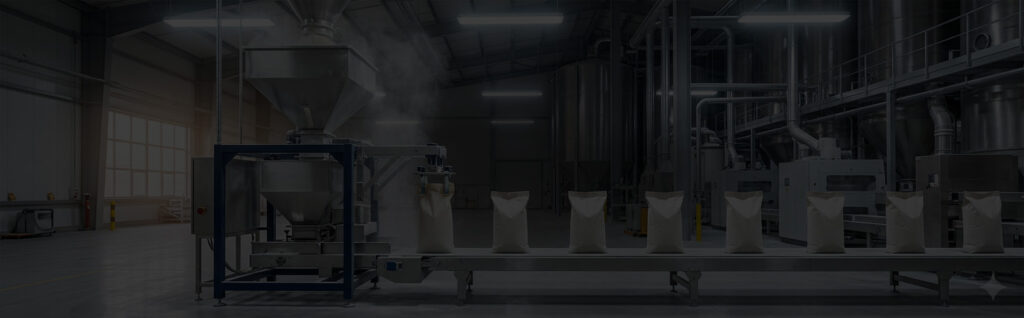
Automatic Bagging Machines for Sale
Net Weight Automatic Bagging Machine
The standard choice for granule and free-flowing powder applications where declared weight accuracy matters — grain, fertiliser, plastic pellets, salt, sugar. Net weight systems weigh the product before bag entry; bag weight variation has zero effect on fill accuracy. Output range 400–1,800 bags/hour depending on product flow rate and bag weight. The ±0.2% accuracy figure assumes product bulk density above 450 kg/m³ and free-flow rating above 60 seconds (Hall flowmeter) — products outside this range need pre-testing.
Gross Weight Bagging Machine
Lower cost than net weight systems; suitable for 25–50 kg industrial bags where ±2g bag weight variation is negligible (0.008% of fill weight). Not recommended for bags below 5 kg where tare variation becomes significant relative to fill weight.
Powder Bagging Machine
Purpose-built for fine powders with bulk density below 600 kg/m³. Dust-tight construction, impeller or screw filling mechanisms. Standard auger fillers block on fine powder — this design addresses that failure mode specifically.
Open Mouth Bag Filling Machine
For PP woven, PE and multi-wall paper bags requiring clamp-and-fill rather than valve injection. Faster bag changeover than valve systems; better suited to products with moisture content that would clog a valve spout.
Valve Bag Packing Machine
For cement, chemical powder and gypsum requiring a fully enclosed, dust-free bag after filling. Valve bags self-seal after spout withdrawal — no additional sealing station. Rotary configurations for throughput above 600 bags/hr.
Automatic Packaging Line
Complete turnkey lines: filler, checkweigher, conveyor, sealer, labeller, palletiser. For producers moving from semi-automatic to lights-out packaging. PLC integration with Siemens or Allen-Bradley standard.
How an Automatic Bagging Machine Works
1. Product Feed & Storage
Hopper receives product from silo or bulk bag. Agitators prevent bridging in cohesive or sticky materials.
⚠ Most speed losses originate here. Hopper geometry must match product flow characteristics — not a standard design.
2. Metering & Weighing
Product measured by weight (load cell, net or gross) or volume (auger or piston). Net weight systems verify dose before bag entry — the bag never receives an incorrect weight.
3. Bag Opening & Filling
Bag picked, opened and clamped at spout. Product discharged in controlled flow. Fill speed is the product of metering rate and bag clamp dwell time — both adjustable.
⚠ Bag opening failures account for 40–60% of unplanned stoppages on standard machines. Discuss your bag supplier before confirming a machine.
4. Sealing & Discharge
Bag sealed by heat seal, sewn top, tape or self-seal valve. Downstream checkweigher confirms fill weight. Conveyed to palletiser or manual stacking area.
The buyers who achieve closest to rated output in week one of production are those who sent us a 200g sample of their actual product before order confirmation. Bulk density, particle size distribution and moisture content determine fill cycle time — and they vary more batch-to-batch than most suppliers acknowledge. A product sample costs nothing. A machine reconfiguration after delivery costs time and money.
Applications of Automatic Bagging Machines
Grain, Rice & Agricultural Products
Multi-head weigher systems dominate this segment. Key variables: seasonal throughput peaks, strict declared-weight regulations, and HACCP-compliant contact surfaces for food applications.
Fertiliser & Agricultural Chemicals
Granule and prilled fertiliser runs well on standard multi-head weigher designs. Corrosive products (ammonium nitrate, potassium chloride) require specific material specifications for contact parts.
Chemical & Industrial Powder
Often requires ATEX-rated components and material compatibility review before any machine is specified. Dust containment is not optional — it is a safety requirement in most jurisdictions.
Cement & Building Materials
High-volume abrasive duty. Standard machines last 3–6 months before wear requires replacement. Cement-specific designs with hardened wear liners and sealed bearing housings are the correct specification.
Animal Feed & Pet Food
Product range within one facility is the challenge: fine meal, crumble, pellets from 2mm to 12mm often on the same line. Changeover time under 15 minutes between bag sizes is achievable with the right design.
Plastic Pellets & Industrial Granules
Standard multi-head weigher or belt weigher designs work well. Key consideration: static charge buildup on plastic pellets can cause bag adhesion and bridging — discuss with us before specifying.
Automatic vs Manual Bagging: What the Numbers Show
| Metric | Manual (2 Operators) | Automatic Bagging Machine |
|---|---|---|
| Output per 8-hour shift (25 kg bags) | ~3,200–3,600 bags 220–225 bags/hr/operator; fatigue-adjusted | 8,000–14,400 bags 1,000–1,800 bags/hr; one supervisor |
| Weight accuracy (25 kg target) | ±50–150 g (scale read + pour control) | ±50 g net weight (load cell, ±0.2%) |
| Labour cost per 1,000 bags (2 operators @ $15/hr) | ~$17–20 | ~$1.50–4 (1 supervisor + machine amortisation) |
| Product give-away (over-fill to avoid short complaints) | 0.3–0.6% of product weight per bag | 0.05–0.15% (machine-controlled) |
| Product loss at $200/tonne — 2M bags/year | ~$30,000–$60,000/year in give-away | ~$5,000–$15,000/year |
What 15 Years of Manufacturing Experience Changes
🔍Pre-Sale Specification Review
Every enquiry goes to an applications engineer before a quote is generated. We have declined orders where the machine type requested would not work for the product described. That costs us short-term revenue and builds every long-term relationship we have. If your product has unusual flow characteristics — tell us. We have a physical test lab and run samples before confirming the design.
🛠️On-Drawing Customisation
Custom specifications — non-standard bag dimensions, explosion-proof zones, modified hopper geometry, integration with existing conveyors — are designed into the machine from the start, not added after a standard machine is built. Off-drawing retrofit always means compromises. We work from your facility layout drawings.
🎓Commissioning & Training Included
Every machine ships with an operator manual, video commissioning guide and spare parts list for the first 2,000 operating hours. Remote video commissioning is included at no charge. On-site engineers are available for complex multi-machine line installations. We don’t consider a sale complete until the machine is running at specification.
📄Full CE Documentation Package
CE marking requires a complete technical file: Declaration of Conformity, risk assessment, circuit diagrams, O&M manual. We provide the full package in English — not a single-page CE certificate. For EU imports this reduces customs clearance time and eliminates requests for supplementary documentation that delay delivery.
Automatic Bagging Machine Specifications
| Parameter | Net Weight Machine | Gross Weight Machine | Powder Bagger |
|---|---|---|---|
| Bag weight range | 1 – 50 kg | 5 – 50 kg | 5 – 50 kg |
| Output (bags/hr) | 400 – 1,800 | 300 – 800 | 200 – 600 |
| Weight accuracy | ±0.1 – 0.2% | ±0.3 – 0.5% | ±0.1 – 0.3% |
| Filling mechanism | Multi-head weigher / belt | Load cell (tare subtract) | Impeller / screw auger |
| Bag types | PP woven, BOPP, kraft, laminate | PP woven, paper | Valve bag, open mouth |
| PLC control | Siemens S7 / AB | Siemens S7 / AB | Siemens S7 / AB |
| Power supply | 380V / 50Hz (custom available) | 380V / 50Hz | 380V / 50Hz |
| CE / ISO 9001 | Standard | Standard | Standard |
| ATEX option | On request | On request | Standard option |
| Lead time (standard) | 15–25 working days | 15–20 working days | 20–30 working days |
Complete Packaging Equipment Range
🧴 Liquid Filling Machine
Piston, overflow, pump and gravimetric filling for beverages, chemicals and pharma. Fill range 50 ml – 30 L.
🌀 Powder Packing Machine
Dust-tight impeller and screw filling for flour, cement, chemical powder and carbon black. IP65 standard.
🏗️ Automatic Packaging Line
Turnkey lines with filler, checkweigher, conveyor, sealer and palletiser. Siemens/Allen-Bradley PLC.
⚖️ Packing Scale
Quantitative packing scales 5 kg – 1,000 kg. OIML R76 certified, ±0.01 kg resolution, RS-485 output.
🏚️ Cement Bagging Machine
Hardened Mn steel wear liners, 6–12 spout rotary packers. 800–2,400 bags/hr. ATEX option.
🔩 Valve Bag Packing Machine
For cement, plaster, gypsum and chemical powder requiring dust-free bag after filling. Self-seal valve.
Questions About Automatic Bagging Machines
What is an automatic bagging machine?
An automatic bagging machine covers the full fill-weigh-seal cycle without continuous manual intervention: bag opening, product feed, weight verification, sealing and discharge. The productivity difference over semi-automatic operation is typically 3–5× the output per operator-hour, with better weight accuracy on every bag. The key distinction from semi-automatic is that the operator is removed from the fill loop — not just from carrying bags. We also call this an automatic bagging system in some configurations.
How much does an automatic bagging machine cost?
Entry-level single-head machines for standard granule applications: $4,000–$8,000 with 400–600 bags/hour output. Mid-range with higher accuracy and variable bag sizes: $12,000–$35,000. The most important cost driver is not the filling mechanism — it is whether you need net or gross weight accuracy, and how many bag sizes you need to run. A single-format machine costs significantly less than a multi-format system. If you are replacing two manual operators at $15/hour fully-loaded, the labour differential alone typically returns a $15,000–$20,000 investment in under 18 months.
What products can be packed in an automatic bagging machine?
Granules and free-flowing pellets with bulk density above 450 kg/m³ work well on standard net weight designs. Fine powders need a different filling mechanism — dust-tight impeller or screw type. Liquids require a completely different machine category. The specification error we see most often: a buyer specifies machine output and bag size without mentioning product bulk density or flowability. Those two numbers determine whether the machine will actually run at its rated speed with their product.
What is the difference between net weight and gross weight bagging?
Net weight: product is weighed before entering the bag — bag weight variation has no effect on fill accuracy. Gross weight: bag plus product are weighed together and tare is subtracted — cheaper but sensitive to bag inconsistency. For 25 kg industrial bags, ±2g bag variation is 0.008% — negligible. For 1 kg retail pouches, ±2g is 0.2% — significant. Our recommendation: if your product is sold by declared weight in any regulated market, use net weight with a downstream checkweigher. It is the standard approach in food, chemical and pharmaceutical applications for this reason.
How long does delivery take for an automatic bagging machine?
Standard catalogue machines: 15–20 working days from order confirmation. Custom-engineered machines with modified hopper, explosion-proof components or non-standard bag dimensions: 35–55 working days. The longest delays we encounter are not in manufacturing — they are in the specification approval phase. Buyers who provide a complete product datasheet (bulk density, particle size, bag dimensions, target speed, accuracy requirement) move to production 2–3 weeks faster than those finalising specs after order placement.
Can an automatic bagging machine be integrated with my existing conveyor?
Yes — but integration complexity varies. A standard discharge conveyor connection is a 1–2 day commissioning task. Integration with an existing PLC network, ERP data feed or non-standard conveyor height requires engineering drawings and confirmation before order. We work from your facility layout drawings. The problematic integrations we see are those where a buyer purchased a standard machine assuming it would fit, then found discharge height or bag transfer direction incompatible. Share your facility layout before confirming an order — it costs nothing and avoids expensive surprises.
What Buyers Say After 12 Months on the Line
Real feedback from three production environments — grain, chemical powder, and cement.
We had specified a machine from another supplier based on a PDF quotation. QingXin’s engineer came back and said the auger pitch wasn’t right for our product bulk density and suggested a different filling head. That kind of pushback was unexpected — and correct.
The chemical powder we pack has variable bulk density depending on batch temperature. I was told by two other suppliers this was ‘not a problem’ without testing. QingXin ran a sample test and recommended a different hopper agitator. 18 months in, the machine has not had a single blockage.
We run the cement packer on two shifts, six days a week. The hardened impeller wear liners lasted 14 months before first replacement — the previous machine needed replacement every 4 months. Maintenance cost in year one was 60% lower than the machine we replaced.
Further Reading
Request a Factory Direct Quote
CE-certified machines, factory pricing, 48-hour quote turnaround.