
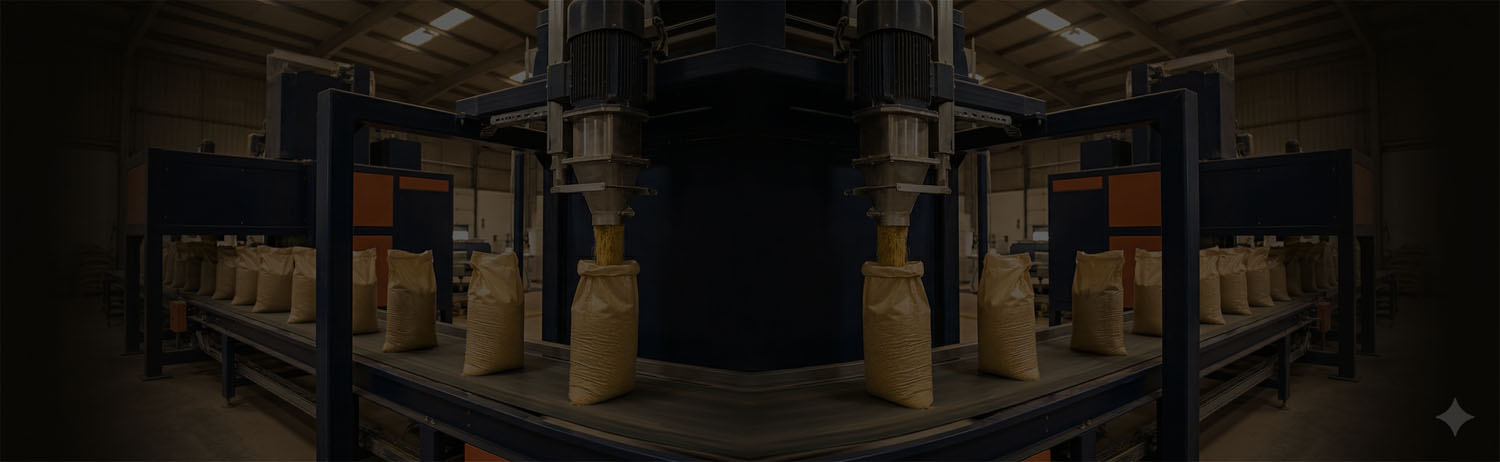
Our Products
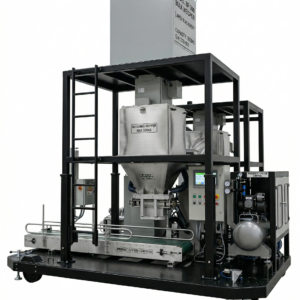
Bagging Machine
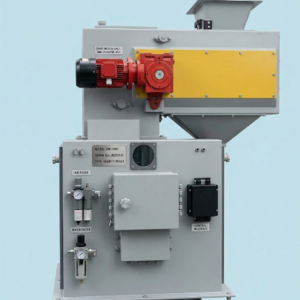
Bagging Machine
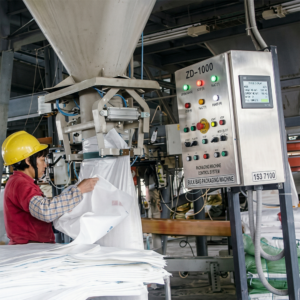
Bagging Machine
Animal Feed Bagging Machine Types
Feed product format — pellets, meal, crumbles, or mixed ration — determines the fill system, de-aeration requirement, and bag handling configuration.
Automatic Pelleted Feed Bagging Machine
Net Weight — Pellets
The most common enquiry in our feed segment. Pelleted compound feed (2–8 mm pellets) is free-flowing with good bulk density consistency, but the high void ratio creates the bag height problem described above. Our standard pelleted feed system includes a de-aeration spear that inserts into the filling bag and vents displaced air through a dust filter, plus a 2-metre vibration conveyor after sealing to settle the bag before it reaches the palletiser.
Net weight filling is standard — not because pellet bulk density varies dramatically, but because formula switching between poultry, swine, and cattle rations involves different pellet sizes that have different packing densities. A single net weight system handles all formulas without recalibration. Tested accuracy at production scale: ±0.3–0.6% for 25 kg bags, measured across 30 consecutive bags in pre-shipment validation.
- Bag weight:10 kg – 50 kg
- Speed:6–12 bags/min (single-spout)
- Accuracy:±0.3–0.6% (net weight)
- De-aeration:Spear + vibration conveyor standard
- Sealing:Bag-top folder + stitcher
Feed Meal & Mash Bagging Machine
Meal & Mash
Ground meal and mash have variable particle size distribution, higher cohesion than pellets, and significant batch-to-batch bulk density variation depending on grinding fineness. Net weight filling is the correct choice. De-aeration requirements are lower than for pellets but a dust extraction hood at the fill spout is essential — meal filling generates significant airborne fines.
- Bag weight:10 kg – 50 kg
- Speed:4–9 bags/min
- Accuracy:±0.5–0.8% (net weight)
- Dust containment:Extraction hood standard
Pet Food & Kibble Bagging Machine
Pet Food
Kibble and expanded pet food have the highest void ratio of any feed product — up to 55% air by volume at fill. Bag height management is critical. Kraft paper bags with PE liner (typical premium pet food format) require a different bag presenter and heat-seal closure vs PP woven bags. Branding print protection on clamp surfaces is specified as standard for premium pet food bags.
- Bag weight:1 kg – 20 kg
- Speed:5–14 bags/min
- Bag formats:Kraft-PE, PP woven, laminated
- Void ratio:High — extended de-aeration
Feed Premix & Mineral Supplement Packer
Premix & Supplement
Vitamin/mineral premixes, trace element supplements, and medicated feed powders in 5–25 kg bags. Variable bulk density, high-value product (overfill is costly), and cross-contamination risk between formulas. Net weight filling with full containment extraction for fine inhalable minerals (selenium, copper sulfate). Flush procedure documented for medicated to non-medicated changeover.
- Bag weight:1 kg – 25 kg
- Speed:4–8 bags/min
- Containment:Full enclosure option for hazardous minerals
- Flush:Documented flush procedure standard
Dual-Spout High-Speed Feed Bagger
Dual Spout
Two independent fill heads on one frame for feed mills needing 12–20 bags per minute at 25 kg. Each spout has its own load cell, bag clamp, and de-aeration system. If one spout requires maintenance, the other continues at half capacity. Matched to a dual-lane bag stitcher — the stitcher is typically the line bottleneck, not the filler.
- Bag weight:10 kg – 50 kg
- Speed:10–20 bags/min
- Spouts:2 independent (each with load cell)
- Redundancy:Single-spout fallback during maintenance
Semi-Automatic Feed Bagger
Semi-Automatic
For small feed mills and farm-based mixers producing under 3 bags per minute. Gravity or auger fill, manual bag placement, foot-pedal trigger. Accurate enough for unregulated internal use but not appropriate for commercial feed under weight regulation. Capital cost $4,000–$8,000 — the gap to automatic net weight is justified once production exceeds approximately 3,000 bags per month.
- Bag weight:10 kg – 50 kg
- Speed:2–4 bags/min (operator)
- Accuracy:±1–3%
- Best for:Farm mixers, small mills, R&D
How an Automatic Feed Bagging System Works
1. Bag Placement & Clamping
Bag is placed manually or by automatic bag placer onto the fill spout. Pneumatic clamps grip the bag mouth. For PP woven bags, clamp pressure is calibrated to hold the bag securely without tearing at the woven edge — 10–15% of buyers who specify standard industrial clamps find they tear the bag mouth on medium-weight PP woven with a tight top hem.
2. De-aeration & Fill
For pelleted and crumbled feed, a de-aeration spear inserts into the bag through a dedicated port before filling begins. This vents displaced air through a dust filter as product fills from the bottom up. The fill gate opens — coarse fill to ~85% of target, then fine fill to set-point. The de-aeration spear withdraws as the bag nears full.
3. Net Weight Cut-Off
Load cell triggers cut-off valve when net weight target is reached, accounting for in-flight product. Fill weight is logged. For formula-switching lines, the PLC recipe system changes the set-point between formulas automatically — no manual adjustment required at changeover.
4. Settle, Fold & Stitch
Filled bag releases onto a vibration conveyor (1.5–3 m) to settle product and reduce headspace. Bag top is folded into a uniform closure and stitched or heat-sealed. Settled and stitched bags stack stably on pallets — un-settled bags do not. This step is where most low-cost feed bagging lines fail to function reliably.
A feed mill in Vietnam commissioned a dual-spout pellet bagging line for layer mash in 2024. After three days of production, the palletiser was rejecting 30–35% of bags for irregular height. The cause was not the filler or the stitcher — the vibration conveyor was running at the same speed as a granule line installation we had done the previous year. Layer mash is significantly less dense than granule products and needs twice the vibration time to settle to a stable bag height. We adjusted the conveyor speed and dwell time, and reject rate dropped to under 2% by end of day. The lesson: de-aeration and settling parameters are product-specific, not universal. We now include a settling time validation as a standard commissioning step on every feed line.
Applications by Feed Type
Poultry Feed
Broiler and layer feed in 25 kg and 50 kg PP woven bags. Crumble feed for chicks requires smaller fill spout geometry than standard pellets. Bulk density varies between pellet diameters (2 mm starter vs 4 mm grower) — net weight filling handles this without recalibration between batches.
Cattle & Dairy Feed
Compound feed and TMR (total mixed ration) components in 25–50 kg bags. Mixed rations with long-particle roughage can bridge in standard fill spouts — spout diameter and agitator specification are sized for mixed ration specifically. De-aeration is less critical than for pelleted feed but a bag vibration station is still recommended for pallet stability.
Swine Feed
Prestarter and starter pellets in 10–25 kg bags. Smaller bag sizes mean higher bag per hour rates — a single-spout system running 10 kg bags produces roughly 2.5× the output in bag count vs 25 kg bags. Conveyor length and stitcher speed must be matched to the higher bag rate.
Aquaculture Feed
Floating and sinking pellets for fish and shrimp in 5–20 kg bags. Floating pellets have the highest void ratio of any feed product (55–65% air). Extended de-aeration and slow bag-settling speeds are required. Moisture barrier bag specification is critical — aquaculture feed bags are often stored in high-humidity environments.
Pet Food & Treats
Premium kibble and extruded pet food in 1.5–15 kg retail bags. Branding print quality and bag presentation matter more than in industrial feed markets. Non-marking clamp surfaces, precise bag orientation for print consistency, and heat seal closure for kraft-PE bags are standard specifications.
Horse Feed & Equine Supplements
Chaff, cubed hay, coarse mix rations, and pelleted horse feed in 15–25 kg bags. Long fibre in chaff and coarse mix requires a wider fill chute and a longer de-aeration spear than standard pellet systems. These are lower-volume markets — semi-automatic systems are often cost-justified unless output exceeds 5,000 bags/month.
Volumetric vs Net Weight for Feed Products
| Parameter | Volumetric (Gravity/Auger) | Net Weight (Load Cell) |
|---|---|---|
| Accuracy — uniform pellet product | ±1–2% | ±0.3–0.6% |
| Accuracy — mixed ration or variable formula | ±3–6% (bulk density variation) | ±0.5–0.8% (auto tare & set-point) |
| Formula changeover recalibration | Required at every formula change (10–20 min) | PLC recipe switch — no recalibration needed |
| Overfill cost (1% overfill, $0.60/kg feed, 10,000 bags/month at 25 kg) | $18,000/month | $4,500/month (0.25% avg) |
| Regulatory compliance (EU weight regulation) | May fail — no per-bag weight record | Per-bag weight log standard |
| Capital cost (single-spout auto) | Lower ($8,000–$15,000) | Higher ($18,000–$32,000) |
| Payback on net weight vs volumetric at 10,000 bags/month | Baseline | Typically 8–14 months from overfill saving alone |
Overfill cost baseline: 10,000 bags × 25 kg × $0.60/kg × 1% overfill = $1,500/month. Net weight saving vs volumetric at these volumes: approximately $13,500/month (1% volumetric overfill vs 0.25% net weight). Actual returns depend on product value and production volume.
Why Feed Mills Choose QingXin Machinery
De-aeration Specification Based on Your Product
Pelleted poultry feed and expanded fish feed have very different void ratios — what works for one will not be calibrated correctly for the other. We ask for pellet diameter, bulk density, and approximate void ratio (or product type) before specifying the de-aeration spear length, vibration conveyor speed, and bag settling time. Generic de-aeration settings produce the bag height problems that generate complaints about the machine when the actual issue is a calibration specification.
Multi-Formula PLC Recipe System
Feed mills producing multiple species formulas on the same line need a recipe management system, not just a set-point dial. Our PLC systems store up to 50 product recipes — fill weight, coarse/fine flow switchpoint, in-flight correction factor, and de-aeration time — selectable by product name at the HMI. Changeover time between formulas is under 2 minutes for a recipe switch; the line can run the next formula within one bag cycle of triggering the changeover.
Medicated Feed Contamination Protocol
Carry-forward of medicated feed residue into non-medicated batches is a serious regulatory issue in most markets — not just a cleanliness concern. We design a documented flush procedure into the machine sequence: quantity of product to flush, collection method for flush product, and cleaning record trigger. For customers subject to feed safety audit (GMP+, FAMI-QS, HACCP), this documentation is part of the machine delivery package, not an afterthought.
Pre-Shipment Speed Test With Your Product Density
Speed tests on feed bagging machines are typically run with a reference product (free-flowing granules). Your product — particularly if it is meal, mash, or a high-void-ratio pellet — will fill at a different rate. We offer pre-shipment testing with a product sample you provide, and the speed test report reflects your actual product performance. If the result is below the quoted speed, we resolve it before shipment rather than after.
Technical Specifications
| Parameter | Semi-Auto | Automatic Single-Spout | Automatic Dual-Spout |
|---|---|---|---|
| Bag weight range | 5 kg – 50 kg | 5 kg – 50 kg | 10 kg – 50 kg |
| Fill accuracy | ±1–3% | ±0.3–0.8% | ±0.3–0.8% |
| Speed (25 kg pellets) | 2–4 bags/min | 6–12 bags/min | 10–20 bags/min |
| Fill principle | Gravity / auger | Net weight (load cell) | Net weight (dual load cell) |
| De-aeration spear | Not included | Standard (pellets) | Standard (pellets) |
| Vibration conveyor | Not included | 1.5–2 m standard | 2–3 m standard |
| Bag types | PP woven, paper | PP woven, paper, PE, laminated | PP woven, paper, PE, laminated |
| Sealing options | Manual stitcher | Stitcher or heat seal | Dual stitcher or heat seal |
| PLC recipes | None | Up to 50 product recipes | Up to 50 product recipes |
| Fill weight data log | No | Per-bag CSV log | Per-bag CSV log (per spout) |
| Power supply | 220V 50/60Hz | 380V 3-phase 50Hz | 380V 3-phase 50Hz |
| Lead time | 10–15 days | 18–25 days | 22–30 days |
Related Packaging Equipment
Automatic Bagging Machine
General-purpose bagging systems for powders, granules, and free-flowing materials including feed ingredients.
Open Mouth Bag Filler
The broader open-mouth bag filling category covering all industrial sack applications including feed.
Grain Bagging Machine
Grain-specific bagging systems for wheat, corn, rice, and dried cereals — including a dedicated corn bagging machine guide covering whole kernel, grits and corn meal fill mechanisms.
Automatic Packaging Line
Complete feed packaging lines integrating filling, sealing, checkweighing, and palletising. For large-scale feed mills shipping in 500–1,000 kg FIBC bulk bags, see our bulk bag filling machine guide.
Frequently Asked Questions
What types of animal feed can these machines pack?
Our animal feed bagging machines handle the full range: pelleted feed, mash and meal, crumbles, mixed ration, premixes, and medicated feed powders. The main handling differences are between pellets (free-flowing, high void ratio, electrostatic issues), meal (cohesive, variable bulk density, dusty), and mash (mixed particle sizes, bridges easily). Each requires different fill spout geometry, de-aeration settings, and in some cases different bag clamping pressure.
Why is de-aeration important for animal feed bagging?
Pelleted and crumbled feeds have high void ratios — 35–50% air by volume in the fill stream. If the bag is not de-aerated before sealing, the air expands as the bag settles on the pallet, causing bags to bulge and lower-layer bags to split. A bag that looks correct immediately after filling can be 20–30% over its nominal height 20 minutes later. De-aeration spears plus vibration conveyor settling are not optional for pallet-stacked bags — they are the difference between a stable delivery pallet and one that arrives deformed.
What is the filling accuracy for animal feed bagging machines?
Net weight systems with load cells achieve ±0.3–0.8% at production scale. Volumetric systems on pelleted feed are typically ±1–2% if the pellet size and bulk density are consistent. The problem with volumetric filling for mixed rations is significant: a density shift of ±5% between formulas causes a ±5% weight error that must be corrected manually. For feed mills running more than 3–4 product formulas on the same line, net weight filling is the practical choice.
What bag types are used for animal feed?
PP woven sacks (10–50 kg) are the dominant format for bulk industrial and commercial feed. Multi-wall kraft paper bags (5–25 kg) are used for premium pet food and some medicated feed lines. PE film and laminated bags cover the retail pet food segment. Each bag format requires different bag presenter tooling and sealing method — stitching for PP woven, glue or tape closer for paper, heat seal for PE.
How do I prevent cross-contamination between feed formulas?
Changeover contamination is a genuine problem on mixed-use feed lines — particularly on medicated feed lines where medication carryover into non-medicated batches is a regulatory risk. CIP systems are available but require water recovery. Dry-flush systems are faster for non-medicated changeovers. For medicated feed lines, we recommend dedicated equipment or a documented flush procedure that is validated and recorded — this is included in our machine delivery package.
What is the filling speed for an animal feed bagging machine?
For 25 kg pellet bags: single-spout automatic 6–12 bags per minute; dual-spout 10–20 bags per minute. The limiting factor is usually not the filler — it is the bag settling time after filling. Bags of pelleted feed that have not been de-aerated cannot be palletised immediately; they need 30–60 seconds on a vibration conveyor. If your palletiser is the downstream constraint, specify a longer de-aeration conveyor rather than a faster filler.
Does the machine handle bags with printed branding?
Yes. The bag handling system is designed to handle pre-printed PP woven bags without scuffing the print surface. Clamp contact areas use non-marking materials. Bag orientation on the fill spout maintains a consistent print face direction for automated palletising. For bags with metalized or high-gloss print finishes, the vacuum cup specification may need adjustment — standard rubber cups can leave ring marks on glossy finishes. We specify this during the sample bag review.
What Buyers Say After 12 Months on the Line
Real feedback from three production environments — grain, chemical powder, and cement.
We had specified a machine from another supplier based on a PDF quotation. QingXin’s engineer came back and said the auger pitch wasn’t right for our product bulk density and suggested a different filling head. That kind of pushback was unexpected — and correct.
The chemical powder we pack has variable bulk density depending on batch temperature. I was told by two other suppliers this was ‘not a problem’ without testing. QingXin ran a sample test and recommended a different hopper agitator. 18 months in, the machine has not had a single blockage.
We run the cement packer on two shifts, six days a week. The hardened impeller wear liners lasted 14 months before first replacement — the previous machine needed replacement every 4 months. Maintenance cost in year one was 60% lower than the machine we replaced.
Further Reading
Request a Factory Direct Quote
CE-certified machines, factory pricing, 48-hour quote turnaround.