
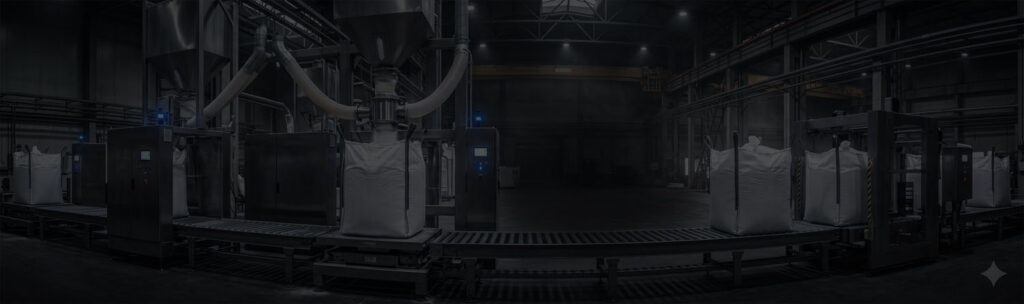
Three Levels of Big Bag Filling Automation
Big bag filling machines are sold across a wide automation spectrum. The right level depends on throughput requirement, labour cost in your facility, and product characteristics:
| Level | Description | Bags/Hour | Operators Required | Best For |
|---|---|---|---|---|
| Manual / semi-automatic | Operator places bag on hooks, connects spout, initiates fill cycle; removes filled bag by forklift | 4–8 | 1–2 | Low volume, multiple product SKUs, tight floor space |
| Semi-automatic with pallet conveyor | Operator places empty bag; pallet conveyor moves filled bag to collection point automatically | 8–15 | 1 | Medium volume, single shift operation |
| Fully automatic | Automatic bag placement, filling, densification and conveying; operator monitors only | 15–30 | 0.5 (monitoring only) | High volume, continuous operation, minimal labour cost |
The fully automatic option sounds compelling until you look at the bag placement mechanism. Automatic FIBC placement requires consistent bag geometry — the bag loop hooks must be precisely positioned for the automated hook arm to engage. If your bag supplier has dimensional variation in loop placement (which is common in lower-cost FIBC production), automatic placement will jam frequently. We recommend testing automatic placement with 20 bags from your actual supplier before committing to a fully automatic system — we build this test into our commissioning process.
Densification: Why It Matters More Than Most Buyers Expect
When a fine powder fills a big bag, air becomes trapped in the void space between particles. A 1,000 kg fill of calcium carbonate (bulk density 800 kg/m³ loose, 1,100 kg/m³ tapped) can contain 20–30% more air volume than the settled product will occupy. Without densification, the bag ships at partial height and the stacking geometry is unstable. With densification, the bag height reduces by 15–25% and the stacked pallet is structurally sound.
Densification on a big bag filling machine is achieved by one of three methods:
Vibrating pallet table
the pallet vibrates at 30–60 Hz during or after filling; effective for free-flowing powders; the vibration also helps settle product in real time, allowing additional fill before the bag is sealed
Bag massager arms
pneumatic paddles press against the bag sides cyclically; gentler than pallet vibration; better for products that pack excessively under vibration (some fine chemicals)
Dual-stage fill with mid-fill densification
the bag fills to 50–60% of target, densifies, then continues filling; adds 60–90 seconds to cycle time but produces the most stable fill geometry for cohesive powders
If your product is a free-flowing granule (sugar, salt, granulated plastic), densification is usually not needed — the product self-settles during filling. If it is a fine powder (flour, cement, chemical powder), densification is the difference between a bag that ships and a bag that gets rejected by the logistics carrier for unstable stacking.
Load Cell Configuration and Accuracy
Big bag filling machines use either a single load cell under the pallet platform or a four-load-cell configuration at the frame corners. The four-cell configuration is more accurate — it averages four readings and compensates for off-centre loading — but costs more and requires more maintenance. The practical accuracy difference:
Single cell, 500 kg capacity:
±0.3–0.5 kg on a 500 kg fill under stable conditions
Four-cell corner mount, 2,000 kg total capacity:
±0.1–0.2 kg on a 1,000 kg fill under stable conditions
For declared-weight big bags (common in food-grade and chemical export), the four-cell configuration provides the accuracy margin needed for legal metrology compliance. For animal feed and agricultural commodities where ±1 kg tolerance is acceptable, a single cell is sufficient and the cost saving is real.
Big Bag Filling Specific to Difficult Products
Two product categories cause consistent problems on standard big bag filling machines:
Hygroscopic materials (fertiliser, salt, certain chemicals). These products absorb moisture from ambient air during fill. If your fill cycle takes 4 minutes and the ambient humidity is 70% RH, the product surface in the bag is absorbing moisture throughout the fill — meaning the filled bag is slightly heavier than the dry product fill weight. In climate-controlled facilities this is manageable; in open or humid environments, the filler must be enclosed and the fill area climate-controlled, or accuracy will drift with ambient humidity. See our fertilizer packaging machine page for hygroscopic-specific design features.
Products with electrostatic charge (plastic pellets, fine chemical powders). Electrostatic charge causes product to stick to bag walls and the fill tube, creating systematic underfill. Anti-static measures — grounding the fill tube, ionising bars at the fill point, anti-static bag liners — reduce this, but the most effective solution is confirming the product’s surface resistivity before specifying the machine.
Frequently Asked Questions
Is a big bag filling machine the same as a bulk bag filling machine?
Yes — identical equipment, different terminology. “Big bag” is common in European and Asian markets; “bulk bag” in North American markets. Both refer to FIBC filling machines designed for 500–2,000 kg flexible intermediate bulk containers. We supply both markets directly from our factory in Changzhou. See also: automatic bagging machine for smaller bag formats.
What floor space does a big bag filling station require?
A semi-automatic single-spout station (machine only, no conveyor): approximately 2.5 m × 2.5 m footprint, with 4.5–5.5 m clearance height required for bag inflation and filled bag forklift removal. A fully automatic system with infeed and outfeed conveyor: 8–15 m length, 3–4 m width. Confirm ceiling height before ordering — this is the most common installation problem with big bag fillers, particularly in facilities with mezzanine structures or low roof trusses.
How do I specify the right hook height range for my bags?
Filled big bag height varies with fill weight and product bulk density. A 1,000 kg fill of a 700 kg/m³ product in a 90 cm × 90 cm bag will reach approximately 170–180 cm filled height. The machine hook-to-floor height must allow the bag to hang without the bottom dragging on the pallet during fill — typically 50–100 mm clearance. Most adjustable-frame systems cover a range of 1,200–1,800 mm hook height; confirm your filled bag height at maximum fill weight before ordering.
What is the price range for a big bag filling machine?
A semi-automatic single-spout FIBC filler with pallet weighing and manual bag placement: $18,000–35,000. A fully automatic system with pallet conveyor, automatic bag placement, densification and outfeed: $55,000–110,000. The single biggest price driver is densification method — a vibrating pallet table adds $4,000–8,000 to the base price; a dual-stage densification system adds $12,000–20,000. For smaller bag formats (5–50 kg), see our Bagging Machine Buyer’s Guide for specification criteria on valve bags and open-mouth formats.
Ready to specify your big bag filling system? Send us your product bulk density, target fill weight (kg), required bags per hour, and bag dimensions. We’ll return a machine configuration and price indication within 24 hours. Contact Kevin directly — we sell direct without distributors.