The real problem automation solves — and the one it doesn't
The most common framing we hear from procurement teams is “we want to reduce headcount.” That is rarely the actual problem. What manufacturers actually struggle with is consistency at speed — manual lines that run fine at 60% capacity and fall apart at 90%. Automation fixes that. It does not automatically fix upstream process issues, inconsistent raw material specs, or SKU complexity. Those problems follow you into an automated line.
The facilities that get the cleanest ROI from packaging automation are the ones that have already standardized their product specs and production schedules before they buy equipment. The facilities that struggle most are the ones that buy automation hoping it will create that discipline.
Industry figures quote 25–40% labor cost reduction from packaging automation. The real breakdown matters more than the average: roughly 60% of savings come from reallocation(moving operators to higher-value tasks), and 40% from actual headcount reduction through attrition. Very few facilities achieve savings through immediate layoffs — and the ones that try to often see morale and retention problems that offset the gains within 12 months.
The second largest savings category, which is consistently underestimated, is product giveaway reduction. Manual filling and bagging on granular or powder products typically runs 1.5–3% over target weight. On high-value products — specialty chemicals, coffee, nutritional powders — that overfill represents $20,000–$80,000 per year on a single line. Automated net-weight filling typically brings that to 0.2–0.5% over target.
Types of packaging automation systems
Fully Automated Filling & Bagging Lines
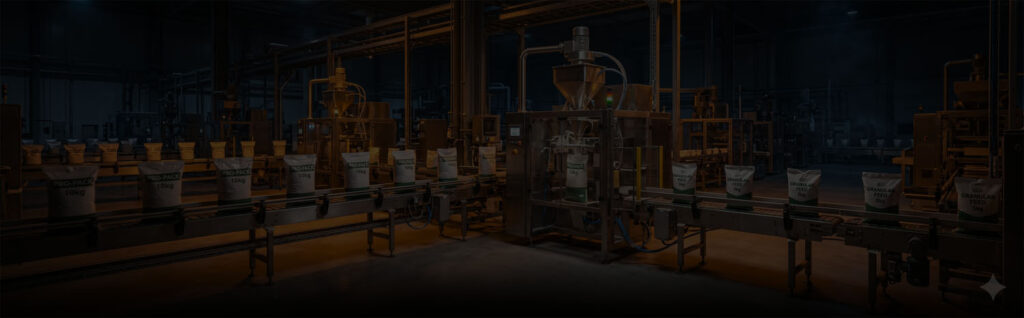
Handles the complete cycle from empty bag to sealed, labeled, palletized product — no per-cycle operator input. PLC-controlled with servo-driven weighers, automatic bag openers, heat sealers, checkweighers, and conveyor integration. Suitable for granules, powders, seeds, pellets, pet food, fertilizer, coffee, and similar free-flowing materials. In our experience commissioning these lines, bulk density variation in the product is the most common issue that delays go-live — worth running a full product trial before finalizing the weigher spec.
Speed range: 200–2,400 bags/hour depending on bag size and product density. Multi-head combination weighers at the upper end; net-weight or gross-weight auger fillers for controlled-flow materials.
Semi-Automatic Systems
Operator positions the bag, machine handles the fill and seal. The right entry point for facilities at 600–1,500 bags/day that are not yet ready for full-line investment. Total system cost typically $15,000–$60,000.
Common limitation: bottleneck is still human-paced. If your target is throughput increase over 40%, semi-auto usually does not get you there.
Robotic End-of-Line Systems
Case packing, palletizing, and depalletizing with collaborative or industrial robots. High capital cost ($150,000–$500,000+ per cell) justified by continuous multi-shift operations.
Payback calculation for these systems should always include the cost of the one or two palletizing operators per shift they replace — at $45,000–$65,000 fully loaded per person per year.
Vertical Form Fill Seal (VFFS)
Forms bags from rollstock film, fills, and seals in one continuous motion. Dominant format for snacks, frozen food, hardware, seeds. Speed up to 120 cycles/minute at small bag sizes.
Key consideration: film compatibility and seal integrity testing takes 2–4 weeks before production commissioning. Do not skip it.
Industry fit and honest limitations by application
Automation does not work equally well across all product types. The table below reflects real-world performance patterns, not equipment marketing claims.
| Product / Industry | Automation Fit | Primary System Type | Key Consideration |
|---|---|---|---|
| Granular / Powder (fertilizer, chemicals, food ingredients) | ● Strong | Net-weight filling, VFFS, open-mouth bagging | Bulk density consistency required; product trials before spec |
| Coffee & Tea | ● Strong | VFFS with gas flush option | Degassing valve integration adds cost; roast timing affects density |
| Pet Food (dry kibble) | ● Strong | Combination weigher + open-mouth bagging | Fragile coatings need gentle handling — verify drop height specs |
| Frozen Food | ● Moderate | VFFS with chiller integration | Condensation management on machinery; higher maintenance cycles |
| Fresh Produce | ● Moderate | Multi-head weigher + VFFS or tray sealer | Irregular shapes and weight variation require more calibration time |
| Pharmaceuticals | ● Strong | Blister packing, strip packing, bottling lines | Regulatory validation (IQ/OQ/PQ) adds 3–6 months to project timeline |
| Liquid / Viscous Products | ● Moderate | Piston or peristaltic filling + capping | Viscosity range affects filler type; foam-prone products need testing |
| Fragile / Irregular Items | ● Requires review | Robotic pick-and-place case packing | Vision system required; slower speeds; custom tooling costs add up |
Packaging Automation System Cost: What the Full Project Actually Runs
The number most buyers miss: Installation, line integration, electrical work, and operator training typically add 20–35% on top of the machine price. A $120,000 filling line becomes a $155,000–$165,000 project by the time it’s running. Budget for the full project before you compare quotes — a lower machine price does not mean a lower project cost.
How to choose a packaging automation system — what to ask before the demo
The most common mistake in equipment selection is evaluating machines by nameplate speed. A machine rated at 1,200 bags/hour that achieves 85% OEE in production delivers 1,020 bags/hour. One rated at 1,000 bags/hour at 95% OEE delivers 950 bags/hour — but with far fewer unplanned stops. For most facilities, uptime consistency is worth more than peak speed.
Five questions that separate suppliers worth talking to from the rest
- “Can we do a product trial with our actual material before you provide a quote?” — Any serious supplier will agree. Those who quote without a trial are guessing.
- “What is your FAT (factory acceptance testing) process, and can we attend it?” — FAT is where problems surface. If a supplier can’t describe it clearly, that’s information.
- “What does your service response look like after installation — hours, not days?” — A production stoppage costs more per hour than most service contracts. Know what you’re buying.
- “What does spare parts availability and lead time look like for the critical wear components?” — Ask about the specific items: sealing jaws, filling valves, drive belts. “We stock parts” is not an answer.
- “Can you provide two references from facilities with a similar product and line configuration?” — Not generic references. Same product type, same size range. Then call them.
Frequently asked questions
How much does a packaging automation system cost?
Entry-level semi-automated systems start around $15,000–$50,000. Fully integrated end-of-line systems with conveyors, case packers, and palletizers typically run $200,000–$800,000+. The honest answer is that the equipment price is rarely the deciding variable — installation, line integration, and operator training often add 20–35% on top of the machine cost. Budget for the full project, not just the hardware.
What is the ROI timeline for packaging automation?
Most facilities running 2+ shifts recover the investment in 12–24 months, primarily through labor reallocation and reduced product giveaway. Single-shift operations typically see payback in 24–36 months. The fastest payback cases involve powder or granular products — manual weighing errors in those applications run $30,000–$50,000 per year in product loss alone.
Can small manufacturers benefit from packaging automation?
Yes — but the entry point is different. At volumes above 600–800 units per day, semi-automated filling or bagging equipment typically pays for itself. Below that threshold, the math gets harder unless your product is high-value, error-sensitive, or runs across multiple shifts. The mistake small facilities make is over-specifying — buying full automation when semi-auto would have done the same job at a third of the cost.
What types of products can be packaged automatically?
Most free-flowing materials — granules, powders, pellets, seeds, nuts, coffee, pet food, fertilizer, chemicals — are strong candidates for automated filling and bagging. Sticky or irregular products (fresh produce, wet foods, fragile items) require more specialized handling. If your product clumps, bridges, or varies significantly in density, disclose this to equipment suppliers upfront — it affects both machine selection and price significantly.
What is the difference between semi-automatic and fully automatic packaging systems?
Semi-automatic systems handle the filling, sealing, or weighing automatically but still require an operator to position bags, load materials, or remove finished product. Fully automatic systems complete the entire cycle — from bag opening to palletizing — without manual intervention per cycle. The choice usually comes down to volume thresholds and labor costs, not technology preference. Many facilities benefit more from semi-auto at two stations than one fully automated line.
How long does it take to install and commission a packaging automation system?
Simple standalone machines: 2–4 weeks from delivery to production. Integrated lines with conveyors, checkweighers, and labelers: 6–12 weeks. Full end-of-line systems: 3–6 months. The step most buyers underestimate is FAT (factory acceptance testing) before shipment and SAT (site acceptance testing) after installation. These are not bureaucratic steps — they are when real problems surface. Skipping or rushing them is where commissioning delays actually originate.
How do I compare packaging automation system suppliers?
Ask three things before you go further with any supplier: whether they run product trials with your actual material before quoting, whether you can attend FAT at their factory, and whether they can name two references with your product type and volume. Suppliers who answer all three clearly are worth talking to. Those who can’t or who quote without a trial are guessing at what will work for your line.
Related resources
Going deeper on a specific system type or component? These pages cover the details:
About this guide
This page is written by the engineering and sales team at Changzhou Qingxin Automation Technology Co., Ltd. We manufacture automatic bagging and filling machines for powder, granule, and liquid applications and ship direct to customers in 30+ countries. The ROI figures, installation timelines, and cost ranges on this page come from our own project records — not industry surveys. If you have questions about a specific product or production volume, contact Kevin directly at kevin@powderbagging.com.