Free material test first
We run your actual product on our machine and send you sample bags plus a test video — before you pay anything.
Nothing upfront
The 30% deposit is due only after you have seen the test results and approved them.
Balance on acceptance
Final payment is due only after the machine passes its factory acceptance test and you sign off.
Factory direct, 15 years
You work with the manufacturer, not a reseller. Our engineers reply to every enquiry within 1 business day.
Big Bag Filling Machine Types
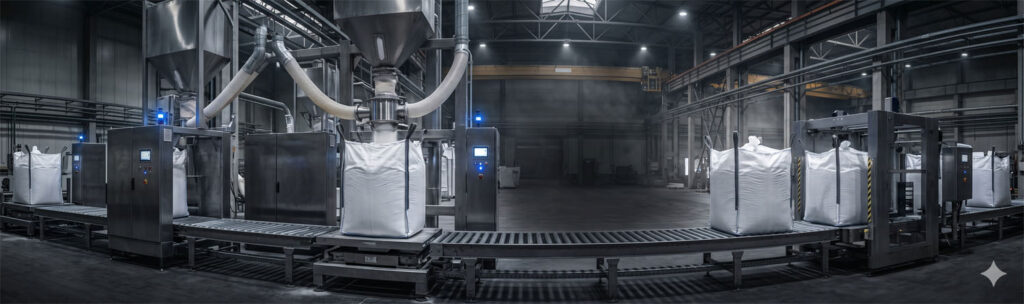
- Standard Big Bag Filler (DCS-Z-S) — Four-hook hanging design, inflator fan, single-stage fill. 8–12 bags/hr. Best for single-product, high-volume operations.
- Palletized Big Bag Filler (DCS-Z-P) — FIBC sits on pallet. Integrated conveyor for automatic pallet in/out. Ideal for warehouse integration with AGV/ASRS systems.
- Dual-Station Big Bag Filler — Two filling heads sharing one feed system. While one bag fills, the other is being removed/replaced. 25–35 bags/hr combined throughput.
- Hazardous-Area Big Bag Filler — ATEX Zone 21/22 certified. Conductive FIBC grounding clamp with continuity monitoring. Nitrogen inerting option for oxygen-sensitive products.
Key Specification Parameters
These four numbers determine which machine configuration fits your application:
- Bag dimensions (L×W×H): Determines hook spacing, fill head height, and conveyor width. Standard range: 800×800×800mm to 1,200×1,200×1,500mm.
- Fill weight: 500–2,000kg. Machines above 1,500kg require reinforced frame + heavy-duty load cells.
- Product flow characteristics: Bulk density (kg/m³), Carr Index, and particle size distribution. These determine feeder type (gravity gate vs. screw vs. belt).
- Throughput target: Bags per hour, including bag changeover time. Single-head: 8–12/hr semi-auto, 15–20/hr auto.
The Fill Cycle: Step by Step
- Bag Placement — Operator hangs FIBC on four load-cell-integrated hooks. Loop detection sensors confirm all four loops are engaged before fill starts. Auto machines use robotic placement.
- Inflate & Seal — Inflator fan opens the bag to full dimensions. Pneumatic fill neck seal engages — no product leakage at the spout-to-bag interface.
- Coarse Fill — Product flows at full rate via gravity or mechanical feeder. Load cells update at 10–50 Hz. PLC monitors fill curve in real time.
- Fine Fill & Cut-Off — At 95% of target, feed rate drops. In-flight compensation algorithm accounts for material between valve and bag. Final cut-off at target weight ±0.1–0.2%.
- Densification & Release — Vibrating table settles product. Hooks release. Palletized version indexes filled pallet out; empty pallet enters. Cycle complete.
Technical Specifications
| Parameter | Value |
|---|---|
| Fill weight range | 500 – 2,000kg |
| Accuracy | ±0.1–0.2% |
| Throughput (single-head) | 8–12 bags/hr (semi-auto); 15–20 bags/hr (auto) |
| Load cells | 4 × shear beam, IP68, OIML R60 C3 |
| Controller | Siemens S7-1200 + 7″ touchscreen HMI |
| Frame | Carbon steel + epoxy (standard); SS304 (food/pharma) |
| Bag types | 4-loop, tubular, liner-bag, UN hazmat, conductive (Type C/D) |
| Fill neck seal | Pneumatic inflatable collar |
| Options | Dust extraction, ATEX Zone 21/22, N₂ inerting, pallet dispenser, stretch wrapper, checkweigher integration |
| Lead time | 25–35 working days (standard); 40–55 days (custom) |
Frequently Asked Questions
Big bag vs bulk bag — what’s the difference?
No difference. Both terms describe FIBC (Flexible Intermediate Bulk Container) filling. “Big bag” is the preferred term in Europe and Asia; “bulk bag” in North America. Our machines handle all FIBC types interchangeably.
Can I fill UN-certified dangerous goods bags?
Yes. Our hazardous-area model includes conductive FIBC grounding with continuity monitoring (<100Ω resistance verified before fill cycle starts), ATEX Zone 21/22 certification, and nitrogen inerting for oxygen-sensitive products. Full UN certification documentation package included.
How do you prevent dust during filling?
Inflatable fill neck seal + integrated dust extraction port. The seal captures 95%+ of airborne dust at the bag-to-spout interface. Balance of extraction volume is matched to the inflator fan volume to avoid negative pressure inside the bag (which would collapse it).
What’s the lead time for a custom specification?
Standard machines: 25–35 working days from order confirmation and deposit receipt. Custom specifications (ATEX, special nozzle materials, GMP documentation) extend to 40–55 days.
What Buyers Say After 12 Months on the Line
Real feedback from three production environments — grain, chemical powder, and cement.
We had specified a machine from another supplier based on a PDF quotation. QingXin’s engineer came back and said the auger pitch wasn’t right for our product bulk density and suggested a different filling head. That kind of pushback was unexpected — and correct.
The chemical powder we pack has variable bulk density depending on batch temperature. QingXin ran a sample test and recommended a different hopper agitator. 18 months in, the machine has not had a single blockage.
We run the cement packer on two shifts, six days a week. The hardened impeller wear liners lasted 14 months before first replacement. Maintenance cost in year one was 60% lower than the machine we replaced.
Further Reading
Request a Factory Direct Quote
CE-certified FIBC filling lines, factory pricing. Free material test on your own product before you pay anything.