
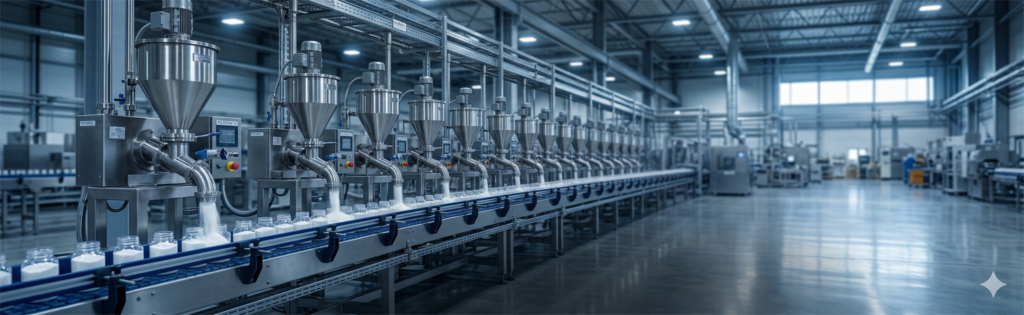
An auger filling machine is the standard choice for dry powder applications where a volumetric fill principle is acceptable — spice blends, protein powder, coffee, pharmaceutical powders, chemical powders under 600 kg/m³ bulk density. It is not the right choice for everything. This guide covers how the machine works, what it handles well, where it fails, and the four numbers you need before specifying one.
Looking to buy? Auger Filling Machine — View Product Page & Get a Quote →
How an Auger Filling Machine Works
The working principle is simple: a rotating helical screw (the auger) inside a vertical tube moves a controlled volume of powder downward with each revolution. The fill weight is determined by the number of auger rotations per fill cycle, the auger pitch (distance between screw flights), and the auger diameter.
A standard auger filling machine fill cycle runs like this:
- Container positioned — the bag, can or jar moves under the fill tube on a conveyor or index plate
- Coarse fill — the auger rotates at full speed for the majority of the fill (typically 80–90% of target weight)
- Fine fill — rotation slows for the final 10–20% to reduce overshoot
- Auger stops, anti-drip activated — a brief reverse rotation prevents powder from dripping between cycles
- Container advances — the filled container exits; the next container indexes into position
Fill speed on a production auger filling machine ranges from 20 to 120 fills per minute depending on container size, target fill weight and product flow characteristics. Smaller containers at 50g fill weight can run at 80–120/min. Larger containers at 1 kg fill weight typically run at 20–40/min.
Auger vs Impeller vs Net Weight: Which Fill Principle for Your Product?
These three principles — auger (volumetric screw), impeller (centrifugal disc), and net weight (gravimetric) — each dominate a different segment of powder filling. The choice is not about preference; it is about product characteristics.
| Fill Principle | Best For | Accuracy | Typical Speed | Weak Point |
|---|---|---|---|---|
| Auger (screw) | Free-flowing powder, 50g–2kg fills | ±0.5–1.5% | 20–120/min | Bulk density variation shifts fill weight |
| Impeller (disc) | Fine, aerated, low-density powder | ±0.5–2% | 30–80/min | Not suitable for granules or coarse powder |
| Net weight (gravimetric) | Bags 5–50kg, declared-weight compliance | ±0.1–0.2% | 4–20/min per head | Slower, higher cost per filling head |
The auger filling machine wins on speed and cost for small-to-mid container sizes. It loses on accuracy when product bulk density varies — if the same product arrives at 420 kg/m³ on Monday and 380 kg/m³ on Friday (due to aeration, humidity or lot variation), the fill volume stays the same but the fill weight shifts by up to 10%. For declared-weight compliance on bags above 5 kg, a net weight system is more appropriate. For small retail containers where 1–2% variation is acceptable and speed matters, an auger filler is the right tool.
Products That Work Well in an Auger Filling Machine
The auger principle works best with products that have stable bulk density and some degree of cohesion — enough that the powder follows the screw without bridging, but not so much that it clumps into the screw flights.
Products that run reliably on an auger filling machine:
- Spices and seasoning blends — consistent particle size, free-flowing, 350–700 kg/m³ bulk density
- Protein powder and meal replacement — standard whey or plant protein at 300–500 kg/m³; maltodextrin-heavy blends may need a dosing auger with agitator
- Coffee (ground) — fine grind at 300–400 kg/m³; coarse grind at 200–300 kg/m³ (may need vibration assist)
- Flour (wheat, rice, corn) — works well with a vertical auger; dusty conditions require sealed fill head
- Chemical powders (stable bulk density) — detergent powder, talc, calcium carbonate; avoid hygroscopic materials without climate control
- Pharmaceutical excipients — lactose, microcrystalline cellulose; pharmaceutical-grade auger fillers include CIP capability and FDA-compliant contact materials
Products That Don’t Work Well in an Auger Filler
Four product characteristics cause failures on an auger filling machine. Knowing them before specifying the machine saves a costly replacement later.
1. Very low bulk density (<200 kg/m³)
Highly aerated powders — fumed silica, aerosil, dry milk powder straight off the spray dryer — compress under the auger screw rather than feeding uniformly. Each rotation moves less product than calculated because the screw compacts the powder ahead of it. An impeller filler handles these products better by using centrifugal force rather than mechanical displacement.
2. Highly variable bulk density
If your product arrives in lots with bulk density variation above ±8%, volumetric fill will produce fill weight variation above your label tolerance. The auger counts rotations, not weight. A net weight system eliminates this problem by weighing each fill directly.
3. Sticky or hygroscopic powders
Powders that absorb moisture from the air — certain sugar blends, some pharmaceutical APIs, ammonium chloride — will stick to the auger flights and build up over a shift, gradually reducing fill weight. These products need either a jacketed auger with dry-gas purge, or a different fill principle with cleanable contact surfaces.
4. Coarse granules above 4 mm particle size
The gap between the auger flight and the tube wall is typically 1–3 mm. Granules larger than this jam the screw, causing blockage and auger motor overload. Granule products above 4 mm particle size run better on a net weight belt-conveyor filler or a bucket elevator filler.
Auger Filler Accuracy: What the Numbers Mean
Accuracy specifications on an auger filling machine are typically quoted as ±X% of fill weight. A ±1% spec on a 500g fill means each container receives 495–505g. That is the machine accuracy under controlled conditions — consistent product, stable bulk density, controlled environment.
Three factors degrade real-world accuracy below the spec plate number:
- Bulk density variation between batches — a 5% bulk density shift produces roughly 5% fill weight shift on a volumetric filler
- Auger flight wear — worn flights increase the gap between auger and tube, reducing fill volume per rotation; accuracy drifts over months without replacement
- Hopper level variation — when the hopper runs low, the head pressure on the auger changes, affecting flow rate into the screw. Most production auger filling machines include a low-level agitator and a refill sensor to keep hopper level stable
Our auger filling machines include adaptive rotation correction: after each fill cycle, the controller compares actual fill weight (via inline checkweigher feedback) against target and adjusts rotation count for the next cycle. This brings real-world accuracy to ±0.5% on most products regardless of bulk density drift.
How to Select the Right Auger Filling Machine
Four parameters determine the correct auger filler specification. Get these numbers before requesting a quote:
1. Fill weight range — minimum and maximum fill weight on the same line. Example: 100g to 1,000g. This sets the auger diameter and gear ratio range. A machine calibrated for 100–500g fills cannot reach 1,000g fill weight without an auger change.
2. Container type and opening diameter — the fill tube must fit inside the container opening. A 32mm fill tube will not enter a spice jar with a 28mm neck. Specify container opening diameter and depth; we size the fill tube and extension nozzle accordingly.
3. Target output (fills per minute) — your required throughput determines whether a single-head or multi-head auger filling machine is needed. A single-head machine running at 40 fills/min produces 2,400 containers/hour. To reach 6,000 containers/hour you need either a 3-head machine or three single-head machines in parallel.
4. Product bulk density (kg/m³) and particle size (mm) — these two numbers confirm the auger principle is appropriate and set the auger pitch. Send a 500g sample if bulk density data is not available; we measure it in our lab at no charge before specifying the machine.
For powder applications that require higher accuracy or involve large bags (5 kg and above), our powder packing machine range includes net weight and impeller options alongside auger configurations — see the comparison table there for the full picture. For a comparison of fill mechanisms and what to specify before buying, our bagging machine buyer’s guide covers the full procurement checklist.
Frequently Asked Questions
Can an auger filling machine handle liquids?
No. The auger principle is designed for dry free-flowing powder and fine granules. For liquid filling, the correct equipment is a piston filler, peristaltic pump filler, or gravimetric liquid filling scale depending on viscosity and volume. An auger in contact with liquid will seize and corrode.
What is the difference between a single-head and a twin-head auger filler?
A twin-head auger filling machine has two fill tubes operating simultaneously, filling two containers per cycle. Output doubles at the same cycle speed. Twin-head machines cost roughly 60–70% more than single-head, but the cost-per-fill is lower above 3,000 containers/hour. Below 2,000 containers/hour, a single-head machine is more economical.
How often does the auger need replacing?
Auger flight wear rate depends on product abrasiveness. For non-abrasive products (flour, protein powder, spice), an auger typically lasts 3–5 years of continuous operation. For abrasive products (calcium carbonate, silica, certain chemical powders), wear is faster — 12–18 months at 3-shift operation. We supply replacement augers cut to your original specification; most customers keep one spare on site.
Can the fill weight be changed without tools?
Yes on electronic servo-drive auger filling machines: the target fill weight is entered on the touchscreen; the controller recalculates the rotation count automatically. On older clutch-brake machines, changing fill weight requires mechanical adjustment of a stop collar. All current models we supply use servo drive with touchscreen recipe storage — changeover between fill weights takes under 2 minutes.