
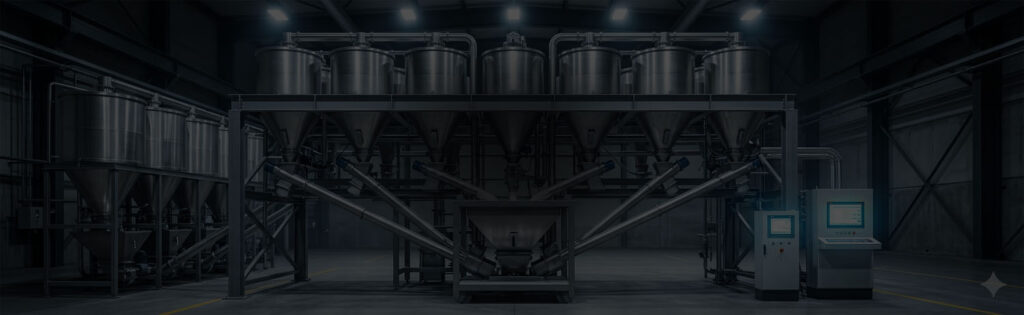
How an Automatic Batching System Works
A batching system combines two or more components to a defined recipe. The weighing sequence depends on whether the system uses a gain-in-weight or loss-in-weight architecture — the two approaches that dominate industrial batching:
Gain-in-Weight Batching
In a gain-in-weight system, all components are weighed into a single vessel (the batch hopper) on a common set of load cells. The vessel starts at zero; each component is added sequentially; the load cell reading increases with each addition.
Sequence for a three-component batch:
- Component A feeds into the vessel until the load cell reads Component A target weight; feed stops
- Component B feeds into the vessel; load cell reads the cumulative weight (A + B); feed stops when the reading reaches A + B target
- Component C feeds; load cell reads A + B + C cumulative; feed stops at total batch weight
- Batch discharges to the mixer or bagging machine
Gain-in-weight is mechanically simple — one vessel, one set of load cells — but has a critical accuracy limitation: each component’s weighing error accumulates on the previous component’s weight. If Component A was 50 g over target, Component B’s feed starts from a reading that is already 50 g high. The error compounds unless the controller applies a correction factor between components.
Loss-in-Weight Batching
In a loss-in-weight (LIW) system, each component has its own supply hopper sitting on its own load cell. The component feeds from the hopper into the batch vessel; the load cell measures how much weight has left the supply hopper (the “loss”). The controller stops feeding when the target weight loss is reached.
LIW systems are more accurate because each component is weighed independently. They are also more expensive — separate hopper and load cell per component, versus one vessel for all in gain-in-weight. For batches with more than three components, or where any single component is less than 2% of the total batch weight (where gain-in-weight accumulated error becomes significant), LIW is worth the additional cost.
Accuracy by Component Weight: What to Expect
Batching system accuracy is not constant across the full weight range. The accuracy specification (±X g or ±X%) applies at rated capacity; at low fill weights, absolute error stays roughly constant while percentage error increases:
| Component target weight | Typical absolute error (well-specified system) | Percentage error |
|---|---|---|
| 500 kg (major component) | ±100–200 g | ±0.02–0.04% |
| 50 kg (secondary component) | ±50–100 g | ±0.1–0.2% |
| 5 kg (minor component) | ±20–50 g | ±0.4–1.0% |
| 500 g (micro component) | ±5–20 g | ±1–4% |
The micro-component row is where most batching problems originate. A component at 500 g in a 1,000 kg batch (0.05% of total) that weighs with ±2% error introduces a ±10 g variation in the final product. For pigments, flavourings, pharmaceutical actives and catalyst components, this level of variation is unacceptable. Micro-components below 1 kg typically require a separate precision batching station with a dedicated high-resolution load cell rather than the main batching scale. On the lines we build, we separate micro-component weighing onto a standalone 0.1 g resolution platform to protect overall batch accuracy.
Feed Mechanisms for Different Material Types
Each component in a batching system requires a feed mechanism matched to its flow properties. Using the wrong mechanism is the single most common cause of batch accuracy failures in our experience:
Gravity gate (slide gate / butterfly valve)
for free-flowing granules and pellets; fast but difficult to control at fine-fill stage; requires a two-stage (fast/slow) gate or a dribble feeder for the final 5–10% of target weight
Vibratory feeder
for materials that flow with vibration assistance but bridge under gravity; useful for fibrous materials and irregular-shaped particles
Screw (auger) feeder
for cohesive powders that won’t gravity-feed reliably; controllable to very low feed rates (50 g/min) by reducing screw speed; preferred for fine chemicals and pharmaceutical excipients
Liquid pump
for liquid components in a batch; gear pump or peristaltic pump depending on viscosity and hygienic requirements
Belt feeder
for materials that cannot be fed by screw (fragile granules, sticky materials); slower than screw but gentler on the product
PLC Integration and Recipe Management
An automatic batching system is controlled by a PLC (Programmable Logic Controller) with a recipe management system. The recipe defines, for each batch: which components to include, the target weight for each, the feed sequence, and the tolerance limits (upper and lower weight limits that trigger a reject or hold flag).
Integration points to confirm with us before purchase:
ERP/MES connectivity
can the batching controller receive recipe downloads from your ERP system, or does every recipe need to be manually entered at the HMI? Recipe download integration eliminates transcription errors but requires IT integration work at commissioning
Batch record output
does the system print or export a batch record showing actual vs. target weight for each component, operator ID, and time stamps? This is required for GMP applications and useful for quality control in any food or chemical application
Alarm logging
when a component fails to reach target weight within the timeout period (feeder jam, empty hopper, load cell fault), the alarm must be logged with time stamp and operator response; confirm the alarm history retention period in the controller
Common Failure Modes in Automatic Batching Systems
Three failure modes account for most batching inaccuracy in production. Note that even a well-tuned batching system will pass occasional weight errors downstream — which is why pairing the line with an automatic checkweigher at the bag-off point catches what the batch controller misses.
In-flight weight error. When a feed gate closes, material already airborne between the feeder and the hopper continues to fall — this is the “in-flight” weight. On a fast-flowing component, in-flight weight can be 200–500 g. If the controller does not compensate for in-flight (closing the gate before the target weight is reached), every batch will be systematically overfilled on that component. In-flight compensation requires calibration runs at production flow rate — not once at commissioning, but after any feeder maintenance that changes the flow rate.
Hopper vibration cross-talk. In a gain-in-weight system with a single batch hopper, vibration from nearby equipment affects the load cell reading. A conveyor running at 10 Hz adjacent to the batch hopper creates a 10 Hz noise signal on the load cell. The controller’s digital filter must be set to reject this frequency, or the batch will end prematurely (the noise spike pushes the reading over the target) or run long (the filter is too aggressive and slows the controller response).
Component bridging. Cohesive powders form bridges across the hopper outlet, stopping flow. The feed mechanism shows zero flow but the controller is waiting for target weight — the batch hangs at 80% of target with no alarm until the timeout triggers. Anti-bridging measures (hopper agitators, vibrators, aeration pads) must be sized for the worst-case product, not the average product.
Frequently Asked Questions
What is the difference between a batching system and a dosing system?
In common usage, “batching” implies discrete batch processing — combine components, discharge the batch, repeat. “Dosing” often implies continuous or semi-continuous operation — adding a controlled quantity of one component to a flowing stream. The hardware overlaps significantly; the control philosophy differs. An automated dosing system continuously controls the ratio of component A to a base stream; a batching system makes discrete batch quantities to a recipe. See also: automatic packaging line for downstream integration.
How many components can a single batching system handle?
Gain-in-weight systems are practical up to 6–8 components — beyond that, the sequential feed time makes batch cycle time impractical. Loss-in-weight systems scale more easily to 12–20 components because multiple components can feed simultaneously (in parallel) rather than sequentially. For formulations with more than 10 components at widely different weights, a hybrid system — LIW for minor components, gain-in-weight for majors — is often the most cost-effective architecture.
What throughput can I expect from an automatic batching system?
Batching throughput is usually expressed in batches per hour rather than kg per hour. A three-component 500 kg batch with gravity-fed free-flowing granules: 6–10 batches per hour (3,000–5,000 kg/hour). The same batch size with cohesive powder components and screw feeders: 3–5 batches per hour (1,500–2,500 kg/hour). Batch discharge and cleaning time between batches (for multi-product systems) is often the binding constraint, not the fill time.
Discuss Your Batching Requirements
We manufacture automatic batching systems and sell direct from our factory — no distributors, no intermediary markup. Tell us your component count, target batch size, material types and required cycle time, and we will confirm the right weighing architecture for your line. We also supply complete downstream packaging: automatic packaging lines and checkweighers for post-fill weight verification.