
Our Products
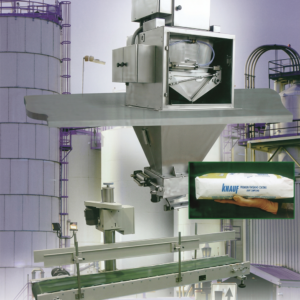
Bagging Machine
DCS-HF Series Electronic Packaging Scale (Fertilizer/Chemical)
Bagging Machine
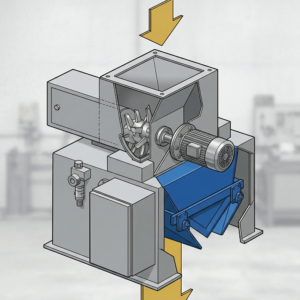
Bagging Machine
DCS-ZA Gravity-Fed (with Agitator) Automatic Packaging Scale
Why Standard Bagging Equipment Fails on Cement
Abrasion Destroys Standard Wear Parts
Cement hardness acts like continuous fine-grit abrasive on mild steel auger screws, impellers, and filling spouts. Standard machines need wear part replacement within weeks. Cement-specific machines use hardened Mn steel liners (HRC 52–58) rated for 12+ months continuous operation — this isn’t a premium option, it’s the minimum for cement duty.
Dust Infiltration Shuts Down Electronics and Bearings
Cement dust at 15–50 microns penetrates standard bearing seals, electrical enclosures, and pneumatic valves. Without IP54-rated housings and labyrinth bearing seals built in from design, maintenance intervals collapse from quarterly to weekly. Dust collection bolted on as an afterthought doesn’t fix this — the machine itself has to be sealed.
Volumetric Filling Cannot Hold Weight Accuracy
Cement bulk density varies ±15% depending on aeration state and temperature. Standard volumetric fillers drift to ±300–500g per bag — commercially unacceptable when buyers pay by the kilo. Cement packers use load-cell weighing with closed-loop feedback to maintain ±100g tolerance regardless of material condition.
Slow Equipment Causes Moisture Pre-Hydration
Cement sitting in undersized hoppers or slow-moving conveyors absorbs ambient humidity and begins partial hydration — causing clumping, inconsistent fill weight, and blocked spouts. High-throughput designs minimise dwell time. Airtight material handling from silo to sealed bag is the only reliable solution.
Cement Bagging Machine Models
6-Spout Rotary Packer
Entry point for rotary technology. Suited to cement plants with a single packing line running one shift, or where floor space constrains a larger carousel. The step up from single-spout impeller filling becomes economically justifiable above 700 bags/hr.
8-Spout Rotary Packer
Our most-ordered cement packer configuration. Balances output, capital cost and carousel diameter for the majority of cement plant layouts. Covers two-shift operations at medium capacity plants without requiring the larger civil works of a 12-spout installation. PLC-controlled with recipe storage for up to 12 product variants.
12-Spout Rotary Packer
High-volume configuration for large cement producers running three shifts or supplying multiple distribution chains from a single bagging station. Requires larger silo throat feed and dedicated dust collection infrastructure. Not cost-effective below 1,500 bags/hr average utilisation.
Single-Spout Impeller Filler
The honest choice for lower-volume operations. At outputs below 600 bags/hr, this machine at a quarter of the cost of a rotary packer delivers comparable output per capital dollar. Simpler mechanically, lower maintenance overhead, easier to train operators on. Purpose-built for cement with the same Mn steel wear specification.
Valve Bag Cement Filling Line
Integrated line combining the rotary packer with bag saddle conveyor, downstream checkweigher with auto-reject, flat conveyor to palletiser, and centralised dust collection. Designed for producers moving to lights-out bagging on a single production floor. PLC integration with plant DCS is standard.
Open-Mouth Cement Bagger
Used where valve bag self-sealing is unreliable — high-moisture cements, certain blended products with elevated gypsum content, or where the buyer’s bag specification uses a non-standard valve. Requires a closing station (sewn-top or heat seal) as a downstream unit. Output is lower than valve bag configurations for the same mechanical footprint.
How a Cement Rotary Packer Works — Step by Step
1. Product Silo Feed
Cement discharges from the silo through a controlled slide gate into the packer’s feed chute. Silo pressure and cement temperature (especially from freshly ground product) are monitored. Hot cement above 65°C changes flow characteristics and requires feed rate adjustment to maintain fill accuracy.
Critical: silo throat diameter must match packer feed capacity — undersizing is the most common installation error we see.
2. Impeller Metering & Valve Bag Injection
The impeller rotates at a controlled speed, feeding cement by centrifugal force into the valve bag spout. Fill weight is controlled by impeller speed and fill time. The bag is seated on the spout by the operator (or automatic bag placer on full-line configurations) and held by spout clamps during filling.
Mn steel impeller blades maintain fill accuracy over 12–18 months; standard carbon steel blades begin degrading in 3–4 months.
3. Weight Check & Valve Self-Seal
When the fill cycle completes, the spout withdraws and the valve bag self-seals. A load cell in the bag saddle provides a fill weight reading before the bag is discharged — bags outside the setpoint trigger a recheck signal. Downstream checkweigher provides a secondary verification and automatic reject gate.
4. Conveyor & Palletising
Filled bags discharge onto a belt conveyor, pass through the checkweigher, and are routed to a palletiser. A flat conveyor section allows bag orientation correction before layer formation. Dust-collection extraction continues at the bag discharge point to manage residual cement on bag exteriors.
Cement dust at the bagging point is a health (silica exposure), regulatory (occupational exposure limits), and accuracy problem (airborne dust near load cells causes false readings). Our machines provide a sealed spout-to-valve connection and a negative-pressure extraction port — but containing cement dust requires an integrated approach. The dust collector must be matched to the extraction volume, the building ventilation must prevent negative pressure from pulling dust out of the extraction hood, and the bag discharge conveyor needs its own extraction point. Plants that treat dust collection as an afterthought consistently report higher maintenance costs and accuracy problems than those who design it into the installation from the start.
Products Packed on Cement Bagging Equipment
Portland Cement
OPC, PPC and blended Portland variants. The primary application. Blaine fineness 3,000–4,500 cm²/g. Bulk density 0.9–1.5 t/m³ depending on aeration state. Self-sealing valve bags; 25 kg and 50 kg formats most common.
Fly Ash
Low bulk density (0.6–0.9 t/m³) and high fineness make fly ash a relatively easy product for the impeller mechanism — but its tendency to aerate and its low density require impeller speed de-rating compared to Portland cement. Fill time is longer per bag.
Gypsum & Plaster
Calcined gypsum and plaster of Paris pack reliably on valve bag equipment. High moisture sensitivity requires good spout valve sealing to prevent moisture ingress between bags during production pauses. Plaster sets in the valve if left idle — purge cycles required.
Dry Mix Mortar
Mixed powder plus aggregate (sand particles up to 3 mm) in a single bag. Variable particle size is the main challenge — recipe storage allows the PLC to maintain consistent fill weights across product variants. Wear rates are higher than for neat cement due to the sand aggregate fraction.
Lime
Hydrated lime (Ca(OH)&sub2;) is less abrasive than cement but more caustic — seal integrity is especially important for operator safety. Quicklime cannot be packed on this platform due to exothermic reaction risk with any residual moisture. Hydrated lime only; confirm product specification before order.
Calcium Carbonate
Ground calcium carbonate (GCC) in fine powder form packs cleanly on this platform. Lower abrasion than cement extends wear liner life further — users packing GCC exclusively typically report 24–36 months on Mn steel liners. Precipitated calcium carbonate (PCC) requires lower impeller speeds due to higher fineness.
Single-Spout vs. 6-Spout vs. 12-Spout Rotary Packer — Which Is Right?
| Parameter | Single-Spout Impeller | 6-Spout Rotary Packer | 12-Spout Rotary Packer |
|---|---|---|---|
| Output (bags/hr) | 200–400 | 800–1,200 | 1,800–2,400 |
| Daily output (16hr, 80% eff.) | 2,560–5,120 bags | 10,240–15,360 bags | 23,040–30,720 bags |
| Wear liner interval (Mn steel) | 12–18 months | 12–18 months | 12–18 months |
| Dust containment | Spout seal + extraction port | Sealed carousel + extraction manifold | Sealed carousel + dual extraction manifolds |
| Capital cost (indicative) | $8,000–$14,000 | $45,000–$70,000 | $110,000–$160,000 |
| Cost per 1,000 bags (capital amortised, 3 yr) | Higher at volume | Optimal 700–1,200/hr range | Optimal above 1,500/hr |
| Minimum throughput for ROI | Any volume | 600+ bags/hr average | 1,500+ bags/hr average |
| Operator headcount | 1–2 per shift | 1 per shift (bag placement) + 1 supervisor | 2 per shift (bag placement) + 1 supervisor |
| Suitable volume (tonnes/day) | Up to ~200 t/day | 200–700 t/day | 700–1,400+ t/day |
| Full automation potential | Limited | Yes (bag placer add-on) | Yes (standard on most installs) |
What Makes a Cement-Specific Manufacturer Different
⚙Designed for Cement, Not Adapted
Our rotary packers are not general powder fillers with a cement option. The bearing housing design, labyrinth seal geometry, Mn steel liner specification, and carousel speed range were developed specifically for cement and similarly abrasive mineral powders. The impeller blade profile is optimised for cement’s bulk density range and flow characteristics. When you order a standard machine, you receive the cement-grade specification — it is not a premium add-on.
📊Specifications with Evidence
We don’t publish liner-life claims without data behind them. Our 12–18 month Mn steel liner interval is based on field measurement from installations in Egypt, India, Pakistan and Vietnam — all high-production, two-shift operations. We maintain a maintenance log database across our installed base and update specifications when field data shows divergence from published claims. If your cement type (high-clinker, slag blend, pozzolanic) is unusual, we will tell you upfront if our field data for that specific material is limited.
🌎60+ Countries, 15 Years Direct
We do not sell through distributors for technical enquiries. When you contact QingXin Machinery, you reach the engineering team that specifies and builds the machine. We have engineers who have been in cement plants across Southeast Asia, Africa, South Asia and the Middle East and understand site constraints that don’t appear in a specification form: low headroom above the silo outlet, compressed air quality issues, local electrical standards, and the gap between what a plant drawing shows and what is actually on site.
📝48-Hour Quote, Fixed Price
We provide a fixed-price quotation within 48 hours of receiving your production parameters. The quotation includes the machine, commissioning documentation, remote commissioning support, and a 12-month warranty on structural components. It does not include items we haven’t been told about. Provide us your target output, bag weight, cement type, available silo height, existing dust collection infrastructure and site electrical standard — and the quote will not change. We have never retrospectively added costs for items that were in the scope at the time of quoting.
Cement Bagging Machine — Technical Specifications
| Parameter | 6-Spout Rotary | 8-Spout Rotary | 12-Spout Rotary |
|---|---|---|---|
| Spout count | 6 | 8 | 12 |
| Output (bags/hr, 50 kg) | 800–1,200 | 1,200–1,800 | 1,800–2,400 |
| Bag weight range | 25–50 kg | 20–50 kg | 25–50 kg |
| Fill accuracy (nominal 50 kg) | ±150–200 g | ±100–150 g | ±100–200 g |
| Wear liner material (standard) | Mn steel (Mn13) | Mn steel (Mn13) | Mn steel (Mn13) |
| Wear liner material (option) | Hard chrome overlay | Hard chrome overlay | Hard chrome overlay |
| Liner replacement interval (2-shift) | 12–18 months | 12–18 months | 12–18 months |
| Impeller drive | VFD, 7.5–11 kW | VFD, 11–15 kW | VFD, 2 × 11–15 kW |
| Carousel drive | VFD, 2.2 kW | VFD, 3.0 kW | VFD, 4.0 kW |
| Bearing protection | Labyrinth seal + positive air purge | Labyrinth seal + positive air purge | Double labyrinth seal + positive air purge |
| Dust collection port | DN150 flange, −500 Pa setpoint | DN150 flange, −500 Pa setpoint | 2 × DN150 flanges |
| ATEX option | Zone 21 (dust) available | Zone 21 (dust) available | Zone 21 (dust) available |
| Control system | Siemens S7-1200 PLC | Siemens S7-1200 PLC | Siemens S7-1500 PLC |
| HMI | 7″ touchscreen | 10″ touchscreen | 12″ touchscreen |
| Product recipes stored | Up to 8 | Up to 12 | Up to 20 |
| Power supply | 380–415V / 50–60 Hz | 380–415V / 50–60 Hz | 380–415V / 50–60 Hz |
| Carousel diameter (approx.) | 3,200 mm | 3,800 mm | 4,800 mm |
| Machine height | 2,600 mm | 2,800 mm | 3,000 mm |
| Certification | CE, ISO 9001 | CE, ISO 9001 | CE, ISO 9001 |
Related Bagging Equipment
Valve Bag Packing Machine
General-purpose valve bag packing for powder products beyond cement.
Powder Packing Machine
Fine powder packing across chemical, food and mineral applications.
Automatic Packaging Line
Full turnkey lines: filler, checkweigher, conveyor, palletiser.
Automatic Bagging Machine
Open-mouth automatic bagging for granules, pellets and free-flowing powders.
Cement Bagging Machine — Frequently Asked Questions
What is the difference between a rotary packer and a single-spout cement bagging machine?
A rotary packer has 6, 8 or 12 filling spouts arranged in a carousel. While one bag is being filled at a spout, the next spout is already positioning the following bag — so throughput scales nearly linearly with spout count. A single-spout impeller filler works sequentially: fill, discharge, reposition, fill. The output gap is significant: a single-spout machine handles 200–400 bags/hr; a 12-spout rotary packer handles up to 2,400 bags/hr. If you’re running below 600 bags/hr and considering a rotary packer, the economics probably don’t work in your favour — a single-spout impeller filler at a quarter of the cost will serve you better until volume justifies the investment.
How long do wear liners last on a cement bagging machine?
On a standard machine not designed specifically for cement, wear liners typically need replacement every 3–4 months under two-shift operation. On our machines fitted with manganese steel (Mn steel, Mn13 grade) liners, the interval extends to 12–18 months under the same schedule. Hard chrome liners are available for particularly abrasive blended cements. The honest qualification: liner life depends heavily on cement Blaine fineness, clinker content, and whether the machine is properly purged at shutdown. Failing to purge before shutdown allows cement to set in the impeller cavity and significantly accelerates wear on restart.
Can the same machine pack fly ash, gypsum and dry mix mortar as well as cement?
Yes — the rotary packer platform handles all four products without a machine change. What changes between products is the impeller speed and fill-cycle timing, both adjustable from the control panel via stored recipes. Dry mix mortar presents a specific challenge: variable particle sizes (fine powder plus sand aggregate up to 3mm) can cause inconsistent fill weights if impeller speed is not tuned per product. Our control system stores up to 12 separate product recipes on the 8-spout model, so operators switch between cement grades or product types without re-tuning.
What dust collection is needed for a cement bagging machine?
Our machines provide two provisions: a sealed spout-to-valve connection containing dust at the fill point, and a negative-pressure extraction port (DN150 flange, −500 Pa setpoint) designed to connect to a bag filter or wet scrubber. The external dust collector is not supplied as standard — most cement plants have central dust extraction, and we size the extraction port to connect to that. If you don’t have central extraction, we specify a standalone pulse-jet bag filter matched to the machine’s extraction volume. ATEX-rated dust collection equipment is available for plants handling coal-blended cements or other combustible dusts. Treating dust collection as an afterthought — bolted on after commissioning — consistently produces higher long-term maintenance costs than integrating it at the design stage.
What fill weight accuracy can be expected from a rotary cement packer?
Our rotary packers achieve ±100–200g on a 50 kg bag (±0.2–0.4%) under stable conditions. Under regulations in most markets, a 50 kg cement bag must not be more than 1% underweight on average, with no individual bag below 2% of nominal weight. Our machines meet those limits comfortably. Accuracy degrades when silo feed is inconsistent, when cement temperature exceeds 65°C (hot cement flows differently), or when the machine runs below 50% speed for extended periods. A downstream checkweigher with automatic rejection is standard on all our full bagging lines and strongly recommended on standalone packer installations — it is the only way to guarantee every bag leaving the line is within regulatory tolerance.
How much does a cement bagging machine cost?
Single-spout impeller filler for cement: $8,000–$14,000. 6-spout rotary packer: $45,000–$70,000. 8-spout rotary packer (most common): $65,000–$95,000. 12-spout rotary packer: $110,000–$160,000. Full bagging plant with rotary packer, dust collection, checkweigher, conveyor and palletiser: $180,000–$420,000. Prices vary with wear material specification, explosion-proof requirements, and regional certification needs. We provide a fixed-price quotation within 48 hours of receiving your production parameters: target bags/hr, bag weight, cement type, silo height available, and whether you need a turnkey line or just the packer.
What valve bag specification is needed for cement bagging?
Valve bags for cement are typically multi-wall paper (3–5 plies) or woven PP with paper liner, with a self-sealing spout valve. The valve diameter must match the machine’s spout diameter — this is not standardised across bag manufacturers, so we provide our spout specification to your bag supplier before their production run starts. For 50 kg bags, film weight is typically 80–100 gsm; below that, the valve self-seal is unreliable. HDPE or BOPP laminate bags are also compatible on our platform. One thing to check: if your bag supplier has changed their valve specification since your last order, confirm the new dimensions against the machine’s spout spec before running production — mismatched dimensions are the most common cause of valve seal failures we are called to investigate.
Is on-site installation support available?
For a standalone rotary packer installed into an existing cement plant with competent mechanical staff, our video commissioning support is sufficient in most cases — we have customers in over 40 countries doing exactly this. For full bagging plant installations, integration with existing silo conveyors, or PLC integration with plant-wide DCS systems, on-site commissioning engineers are strongly recommended. Be direct about your team’s capability in the enquiry — it affects the documentation package, the pre-wiring we complete in the factory, and whether we include on-site time in the quotation. Attempting a complex installation without adequate support is the fastest way to extend your commissioning timeline from weeks to months.
What Buyers Say After 12 Months on the Line
Real feedback from three production environments — grain, chemical powder, and cement.
We had specified a machine from another supplier based on a PDF quotation. QingXin’s engineer came back and said the auger pitch wasn’t right for our product bulk density and suggested a different filling head. That kind of pushback was unexpected — and correct.
The chemical powder we pack has variable bulk density depending on batch temperature. I was told by two other suppliers this was ‘not a problem’ without testing. QingXin ran a sample test and recommended a different hopper agitator. 18 months in, the machine has not had a single blockage.
We run the cement packer on two shifts, six days a week. The hardened impeller wear liners lasted 14 months before first replacement — the previous machine needed replacement every 4 months. Maintenance cost in year one was 60% lower than the machine we replaced.
Further Reading
Request a Factory Direct Quote
CE-certified machines, factory pricing, 48-hour quote turnaround.