Our Products
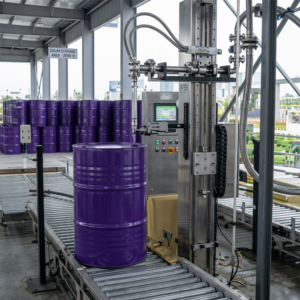
Bagging Machine
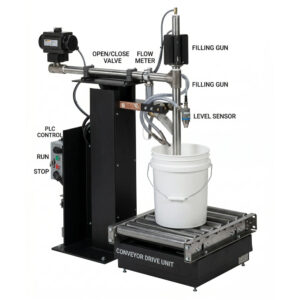
Bagging Machine
YCS30(H)-BU Liquid Filling Scale – 30 kg Small-Container Type
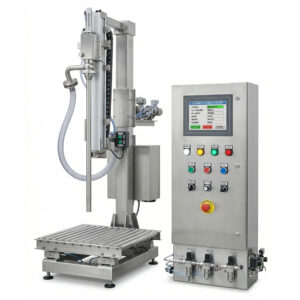
Bagging Machine
Liquid Filling Machine Types
The right filling principle depends almost entirely on viscosity. Choosing by price or by what looks familiar in trade fair photos is how buyers end up with a machine that works in demos but foams, drips, or under-fills in production.
Piston Liquid Filling Machine
Piston Filler
The most common enquiry we get is for sauce, edible oil, shampoo, or lotion — all medium-viscosity products that need consistent fill volumes across shifts. Piston fillers are the right answer for this range (100–5,000 cP), and they are what most production lines in food, personal care, and agrochemicals actually run.
What separates piston fillers is that the fill volume is mechanically set, so drift over a shift is minimal — we typically see ±0.5–1% in production vs ±2–3% with time-gravity alternatives. The trade-off is that they require more frequent seal inspection with abrasive or highly acidic products.
- Fill range:20 ml – 5,000 ml
- Speed:Up to 3,000 containers/hr (single-head auto)
- Accuracy:±0.5–1% at production scale
- Viscosity range:100–5,000 cP
- Contact material:304 SS standard, 316L upgrade
Overflow Liquid Filling Machine
Overflow / Time-Gravity
For water-thin liquids — beverages, water, alcohol, light chemicals — overflow fillers consistently fill to the same visible level regardless of small volume variations. They are fast and gentle on carbonated products but are not the right choice for foaming or high-value liquids where per-fill volume matters precisely.
- Fill range:50 ml – 2,000 ml
- Speed:Up to 8,000 containers/hr (8-head)
- Accuracy:±1–2% volumetric
- Viscosity range:Below 100 cP
Pump Liquid Filling Machine
Pump Filler
Honey, thick lotions, adhesives, and pastes above 5,000 cP need positive displacement pump fillers — gear pump for most applications, lobe pump for hygiene-critical food products. These handle viscosities that would stall a piston filler and allow heated product lines for substances that thicken at ambient temperature.
- Fill range:5 ml – 20,000 ml
- Speed:500–2,000 containers/hr
- Accuracy:±1–2%
- Viscosity range:5,000 cP and above
Liquid Weighing Filler
Gravimetric
Gravimetric filling measures by weight rather than volume, eliminating the accuracy drift that volumetric machines experience when liquid temperature, density, or foam levels vary. Pharmaceutical manufacturers, premium agrochemicals, and high-value specialty chemicals typically specify this type. Accuracy at production scale is ±0.1–0.3%.
- Fill range:100 ml – 25 litres
- Speed:500–2,500 containers/hr
- Accuracy:±0.1–0.3% (production scale)
- Best for:Pharma, agrochem, high-value liquids
Automatic Liquid Filling Machine
Automatic
PLC-controlled, conveyor-integrated lines that handle infeed, filling, capping, and labelling without manual intervention between fills. Standard configuration is 4–16 fill heads with HMI set-point programming. Most buyers running more than one shift per day find the payback on a fully automatic line against semi-automatic is under 18 months.
- Heads:4, 8, 12, or 16 head configurations
- Speed:4,000–30,000+ containers/hr
- Control:Siemens / Delta PLC, HMI touchscreen
- Integration:Capper, labeller, checkweigher ready
Semi-Automatic Liquid Filler
Semi-Automatic
Foot-pedal or sensor-triggered single-head fillers for R&D labs, startups, and production volumes under 500 containers/hour. Lower capital cost and simpler maintenance. Not the right choice for 2-shift operations — at that volume, labour cost makes a fully automatic line cost-effective within a year.
- Fill range:5 ml – 5,000 ml
- Speed:500–1,500 containers/hr (operator-dependent)
- Price range:$800–$2,500 typical
- Best for:R&D, startups, small production runs
How a Liquid Filling Machine Works
Four stages are common across all automatic filling lines. Where they differ is in how stage 2 — metering — is implemented, and that choice determines everything about accuracy and maintenance requirements.
1. Product Feed & Surge Tank
Liquid is fed from a bulk tank into a small surge tank above the filler heads. The surge tank maintains consistent head pressure regardless of bulk tank level — without it, fill volumes drift as the bulk tank empties. This is the most commonly skipped specification in cheap fillers.
2. Metering — Volume or Weight
Piston fillers: a precision-ground piston draws a fixed volume per stroke. Overflow fillers: a valve holds open for a timed duration. Gravimetric fillers: load cells measure weight in real time and close the valve when the set-point is reached. Each has different drift characteristics over a shift.
3. Nozzle Delivery & Drip Control
Fill nozzles rise to meet the container bottom (bottom-up filling), then retract as filling progresses to reduce foam and splashing. Anti-drip valves with spring-tensioned seats prevent post-fill dripping. Poor anti-drip design is the source of most contamination and underfill complaints on cheap machines.
4. Container Discharge & Spacing
Star wheels index containers onto the filler carousel at a controlled rate. After filling, the container exits onto the outfeed conveyor. Checkweigher integration at this stage catches out-of-tolerance fills before capping — particularly important for pharmaceutical and regulated chemical applications.
The most consistent production issue we see during first-week commissioning is surge tank sizing. Engineers often specify the smallest possible surge tank to save space — then the bulk tank pump cycles 40–50 times per hour and pressure fluctuation causes ±3–5% fill variation. We now include a minimum surge tank sizing calculation in every technical review before build sign-off. If your current line shows shift-to-shift fill drift with no apparent mechanical cause, check your feed pressure consistency before replacing the filler.
Industries & Applications
The fill principle, material specification, and regulatory requirements vary significantly between industries. Below is how we typically specify fillers for each sector.
Food & Beverage
304 stainless steel contact parts, CIP-compatible nozzle design, and NSF/FDA-compliant seals. Overflow fillers dominate beverage lines. Piston fillers handle sauces, oils, and dressings. CIP systems (Clean-In-Place) are standard, eliminating manual disassembly for daily sanitation. Conventional dyeing uses 80–100 L of water per kg; our CIP systems recover and recycle 60–70% of rinse water.
Pharmaceutical
GMP-compliant build: 316L stainless throughout, Ra ≤0.8 µm surface finish on product-contact surfaces, no dead-legs in the product path. Gravimetric filling is typical for vials, syrups, and injectables where ±0.1% accuracy is a regulatory requirement. Full audit documentation and material traceability certificates provided.
Chemicals & Solvents
Corrosive liquids require PTFE-lined product paths and 316L stainless. Flammable solvents need ATEX Zone 1 or Zone 2 electrical classification — this must be specified at order stage, not retrofitted. We supply ATEX-rated motors, control panels, and junction boxes as a build option. Buyers in the European market increasingly require ATEX certification for organic solvent lines.
Cosmetics & Personal Care
Shampoos, lotions, serums, and creams span a wide viscosity range that often changes seasonally. Piston fillers with interchangeable piston assemblies handle most personal care products. Heated product lines (up to 85°C product temperature) are available for wax-based formulations that thicken at ambient temperature.
Agrochemicals & Pesticides
Gravimetric filling is standard for high-value concentrates where a 2% overfill on a $40/litre product costs thousands per month in giveaway. Corrosion resistance and ATEX classification are required for most formulations. Container compatibility testing (seal material vs. product) is critical — we provide a material compatibility table in the technical review.
Lubricants & Industrial Oils
Heavy gear oils and greases above 5,000 cP need gear pump fillers with heated lines for consistent viscosity control. The key specification is fill temperature: most gear oils are specified at 40°C viscosity, but filling typically happens at 20–25°C, meaning viscosity is 3–5× higher than the spec figure. This is the source of most capacity shortfalls on oil filling lines.
Volumetric vs Gravimetric: Fill Accuracy & Cost
For most buyers, the right question is not “which type is better” but “which type’s trade-offs I can live with at my production volume.” Here is what the numbers actually look like.
| Parameter | Time-Gravity / Overflow | Volumetric Piston | Gravimetric (Weighing) |
|---|---|---|---|
| Fill accuracy (production scale) | ±2–4% | ±0.5–1% | ±0.1–0.3% |
| Max speed (8-head auto) | 12,000–20,000/hr | 6,000–10,000/hr | 3,000–6,000/hr |
| Density/temperature sensitivity | High — level varies with temp | Medium — volume drifts ±0.5%/5°C | None — weight is absolute |
| Monthly giveaway cost at 100,000 fills (valued at $5/L) | $3,000–$6,000 (3% avg overfill) | $750–$1,500 (0.75% avg) | $100–$300 (0.2% avg) |
| Changeover time (different fill volume) | 30 sec (timer reprogramming) | 5–10 min (piston adjustment) | 30 sec (set-point reprogramming) |
| Maintenance intensity | Low — no moving metering parts | Medium — seals every 3–6 months | Low — load cell calibration annually |
| Base machine cost (8-head auto) | Lowest | Medium | Highest (+30–50% vs volumetric) |
| Regulatory suitability | Food, general industrial | Food, personal care, industrial | Pharmaceutical, agrochem, regulated |
Giveaway cost baseline: 100,000 fills/month × 1 litre mean fill × product valued at $5/litre. Actual giveaway depends on your fill volume and product value — contact us for a calculation specific to your line.
How to Choose the Right Liquid Filling Machine
Most buyers come to us after one failed purchase. The machine ran in the supplier demo but fell apart on their actual product. Here is the checklist we use before recommending any liquid filling machine to a new client.
| Selection Criterion | What to Measure | Why It Matters |
|---|---|---|
| Viscosity | Test at operating temperature (not room temp) | Viscosity changes 30–50% between 20°C and 40°C for oils and sauces |
| Foaming tendency | Pour test: does product foam on contact with air? | Foaming products need bottom-up fill nozzles or slower flow rates |
| Container type | Rigid bottle, flexible pouch, drum, or IBC | Each requires a different clamping, indexing, and nozzle design |
| Fill range | Minimum and maximum fill volume per container | A 10:1 range is achievable; wider ratios need two machines |
| Required accuracy | Regulatory requirement or customer spec in % | Food: OIML R76 ±1.5% typical. Pharma: ±0.5% or tighter |
| Output target | Containers per hour at peak production | Drives head count, conveyor speed, and upstream buffer tank size |
| CIP/cleaning requirement | Allergen cross-contamination risk? Hot-wash cycle? | Determines wetted-part material and nozzle changeover design |
Liquid Filling Machine Manufacturer — Why Buyers Choose QingXin
Most of what differentiates suppliers in this category is not claimed on their websites — it shows up in commissioning, in documentation quality, and in what happens when something goes wrong 6 months post-delivery.
Pre-sale Viscosity & Fill Principle Review
Before we quote, we ask for your product’s viscosity (cP), temperature at filling, fill volume range, container geometry, and target speed. This is not a sales exercise — it directly determines which machine category, nozzle type, and contact materials we specify. We have declined orders where the buyer’s stated fill principle was wrong for their product, because a failed installation is worse for both parties than no sale.
CE Technical File — Not Just the Mark
CE marking on imported machinery is only legally valid if the manufacturer holds a complete technical file: risk assessment, wiring diagrams, component conformity, test records. We have provided these documents for buyers who needed them for customs clearance in Germany, France, and the UK. Ask any supplier for their technical file — the answer tells you quickly whether their CE mark is substantive or decorative.
Speed Test Reports Before Shipment
We run every automatic line at rated speed with water before shipment and provide a signed test report: actual BPH achieved, fill accuracy across 30 consecutive samples, and cycle time at each setting. Buyers who have had equipment arrive slower than spec’d and had no recourse understand why this matters. The test report gives you a performance baseline to hold us to.
Spare Parts Shipped with the Machine
Standard machines ship with a 2-year consumable kit: seals, nozzle O-rings, fuses, and the fill nozzle springs that are the first items to fatigue. Waiting 3 weeks for a $15 seal from overseas stops a production line — we have seen it. Custom parts lists are provided so buyers can source locally after the included kit is depleted.
Technical Specifications
| Parameter | Semi-Automatic | Automatic Single-Head | Multi-Head Rotary (8-head) |
|---|---|---|---|
| Fill volume range | 5 ml – 5,000 ml | 20 ml – 5,000 ml | 50 ml – 5,000 ml |
| Fill accuracy | ±1–2% | ±0.5–1% | ±0.3–0.8% |
| Speed | 500–1,500 containers/hr | 1,000–3,000/hr | 8,000–20,000/hr |
| Viscosity range (cP) | 1–30,000 | 1–10,000 | 1–5,000 |
| Fill heads | 1 | 1–2 | 4, 8, 12, or 16 |
| Nozzle type | Piston / gravity | Piston / pump / overflow | Piston / overflow / gravity |
| Product contact material | 304 SS / PTFE | 304 SS / 316L option | 304 SS / 316L option |
| Control system | Manual / foot pedal | PLC + touchscreen HMI | Siemens / Delta PLC |
| CIP compatible | Manual clean | CIP optional | CIP standard |
| Power supply | 220V 50/60Hz | 220V / 380V 50Hz | 380V 3-phase 50Hz |
| ATEX version | Not available | Available on request | Available on request |
| Lead time | 10–15 days | 15–20 days | 20–35 days |
| Warranty | 12 months | 12 months | 12 months |
Download Product Catalog
Download our liquid filling machine catalog (PDF) for full technical specifications, fill accuracy grades, and pricing guidance. Share it with your production or procurement team.
Why Buyers Trust Our Liquid Filling Machines
We have designed and shipped liquid filling machine systems to food processors, chemical blenders, and pharmaceutical packagers across 30+ countries. Our engineering team reviews every order against the actual liquid’s viscosity, foaming behaviour, and container spec before we confirm a machine type — because the wrong fill principle costs more to fix than the machine itself.
200+
Filling lines shipped since 2008. Every machine leaves our factory with a full-speed fill test report signed by QC.
±0.2%
Fill accuracy on gravimetric models under controlled conditions. Piston models hold ±0.5% across a full 8-hour shift.
30+ Countries
Active installations across the US, Germany, Australia, Southeast Asia, and the Middle East. Local spare-parts stock available in key markets.
CE + ISO 9001
Full CE technical file included. We do not sell CE-marked machines without the declaration of conformity and risk assessment documentation.
Related Packaging Equipment
Liquid filling is typically one stage in a broader packaging line. These are the downstream and parallel machines buyers most commonly pair with a liquid filler. For liquid-specific products, see our dedicated pages: IBC Filling Machine (300–1,200 kg IBC tanks, 60 fills/hr) and Drum Filling Machine (10L cans to 200L drums, up to 100 drums/hr).
Automatic Bagging Machine
Net weight and gross weight filling for powders, granules, and free-flowing dry products. Often integrated on the same line as liquid fillers for mixed-product facilities.
Powder Packing Machine
Auger and impeller-based filling for fine powders and poor-flowing products. Covers the dry side of what liquid fillers can’t handle.
Automatic Packaging Line
Complete turnkey packaging systems integrating filling, sealing, checkweighing, and palletising. Includes liquid filler as a line component.
Packing Scale
Standalone gravimetric packing scales for industrial materials. Gravimetric fill principle used in our liquid weighing fillers is the same underlying technology.
Frequently Asked Questions
What types of liquids can be filled with these machines?
The honest answer is that viscosity is the determining factor, not the liquid name. Thin liquids below 100 cP (water, juice, beverages, light oils) suit overflow or time-gravity fillers. Medium viscosity 100–5,000 cP (sauces, syrups, shampoo) work best with piston fillers. High viscosity above 5,000 cP (honey, thick lotions, adhesives) need pump fillers — specifically gear pump or lobe pump variants. Corrosive liquids and solvents require 316L stainless steel or PTFE-lined contact parts. If you tell us your product’s viscosity and temperature at filling, we can specify the right configuration in the quote.
How much does a liquid filling machine cost?
Semi-automatic single-head piston fillers start around $800–$2,500. Fully automatic single-head machines with PLC control run $3,500–$8,000. Multi-head rotary fillers (8–16 heads) for high-speed lines typically land at $15,000–$45,000 depending on fill volume range, materials, and integration requirements. The biggest cost drivers are the number of fill heads, whether you need 316L stainless vs 304, and any explosion-proof (ATEX) electrical classification. Custom container-handling tooling adds $1,000–$4,000 on top of base machine price.
What is the difference between volumetric and gravimetric filling?
Volumetric filling measures a fixed volume per cycle using a piston or flow meter. It is fast and cost-effective, but accuracy drifts if liquid temperature or density changes — a 5°C temperature shift in edible oil changes fill weight by 0.4–0.8%. Gravimetric (weight-based) filling ignores density variation and delivers ±0.1–0.3% accuracy at production scale. For pharmaceutical, agrochemical, and premium food applications where fill weight tolerance is specified on the label, gravimetric is the right choice. For water-thin beverages on a high-speed line where speed matters more than sub-1% accuracy, volumetric is more practical.
What filling speed should I expect?
Semi-automatic machines: 500–1,500 containers/hour, operator-dependent. Single-head automatic: 1,000–3,000/hour. 4-head rotary: 4,000–8,000/hour. 8-head rotary: 8,000–20,000/hour. 16-head: up to 30,000+/hour. These are published ranges — actual speed on your line depends on container style (bottle neck width is the usual bottleneck), conveyance speed, and fill volume. For fills under 50 ml or over 5 litres, expect the lower end of the range. We run speed validation tests before shipment and provide signed test reports.
Can the machine handle multiple container sizes without a full changeover?
On most platforms, switching container height requires a height-adjustment crank (no tools, 5 minutes) and switching fill volume requires reprogramming the PLC set-point (30 seconds). Switching container diameter — where the star wheel and guides are involved — takes 15–30 minutes with tooling. If you have 3 or more container diameters, we typically recommend quick-change format parts at the design stage. Retrofitting them later is possible but costs more. Tell us your container range upfront and we will build the changeover specification into the quote.
What certifications come with the machine?
CE marking is standard on all machines we export to Europe and most other markets. ISO 9001:2015 covers our production quality system. For food and pharma applications, contact parts are 304 or 316L stainless steel meeting FDA 21 CFR and EU 1935/2004 food contact material requirements. ATEX-rated electrical components are available for flammable solvents — this is a build-time option, not a retrofit. We provide full CE technical documentation including Declaration of Conformity and risk assessment, which some buyers need for customs clearance.
How long does delivery take and what does installation support look like?
Standard lead time is 15–25 days from order confirmation and deposit receipt. Complex multi-head rotary lines with custom conveyance take 30–45 days. We ship disassembled in wooden crates with installation manuals and video guides. For buyers who want on-site commissioning, we can arrange engineer dispatch — typical cost is travel plus $200–$350/day depending on destination. Most buyers in Southeast Asia and the Middle East handle installation themselves with our video support. European buyers often request on-site support; we have covered that in 20+ countries.
Is customization available for my production line?
Yes. The areas we most commonly customise are: fill volume range (we can build pistons or flow-meter heads for anything from 5 ml to 20 litres), container handling (custom star wheels, grippers, conveyors for your bottle geometry), material upgrades (316L throughout, PTFE seals, Hastelloy for aggressive chemicals), and integration with upstream/downstream equipment. OEM labelling and white-label shipping documentation are available. We do not do minimum order quantities on custom machines — buyers routinely order one machine, take delivery, evaluate it, and order more.
What viscosity range can a liquid filling machine handle?
Viscosity range depends on the fill principle. Overflow and gravity fillers work from 1–200 cP (water, alcohol, juice). Piston fillers handle 200–5,000 cP (sauces, edible oils, shampoo). Gear pump fillers extend coverage to 50,000+ cP for honey, adhesives, and thick pastes. We ask for your viscosity data before recommending any machine — a mismatched fill head is the single most common cause of poor fill accuracy.
What is a liquid filling machine price range?
Entry-level semi-automatic piston fillers start at USD 2,000–4,000. Automatic single-head machines with PLC and conveyor run USD 8,000–18,000. Multi-head rotary lines for high-volume food or chemical production range from USD 25,000–80,000+. The largest variable is head count and fill accuracy grade — gravimetric systems cost 30–50% more than volumetric equivalents of the same speed.
How do I clean a liquid filling machine between product changeovers?
Most of our automatic machines support CIP (clean-in-place) cycles where cleaning fluid circulates through the fill path without disassembly. For products that cannot share contact surfaces (allergens, pharmaceutical grades), we supply quick-disconnect nozzle sets so operators swap heads in under 10 minutes. All wetted parts on our standard range are 316L stainless steel and EPDM seals — both compatible with hot-water and caustic wash cycles.
Can a liquid filling machine run both bottles and drums on the same line?
Not on the same filler head — container height, neck diameter, and fill volume are too different. The practical solution is a dedicated small-container filler (20 ml–5 L) on one line and a drum filler (20–200 L) on a second. We supply both configurations and can design a shared upstream tank and pump system so the same liquid batch feeds both lines from one preparation point.
What Buyers Say After 12 Months on the Line
Real feedback from three production environments — grain, chemical powder, and cement.
We had specified a machine from another supplier based on a PDF quotation. QingXin’s engineer came back and said the auger pitch wasn’t right for our product bulk density and suggested a different filling head. That kind of pushback was unexpected — and correct.
The chemical powder we pack has variable bulk density depending on batch temperature. I was told by two other suppliers this was ‘not a problem’ without testing. QingXin ran a sample test and recommended a different hopper agitator. 18 months in, the machine has not had a single blockage.
We run the cement packer on two shifts, six days a week. The hardened impeller wear liners lasted 14 months before first replacement — the previous machine needed replacement every 4 months. Maintenance cost in year one was 60% lower than the machine we replaced.
Further Reading
Request a Factory Direct Quote
CE-certified machines, factory pricing, 48-hour quote turnaround.