
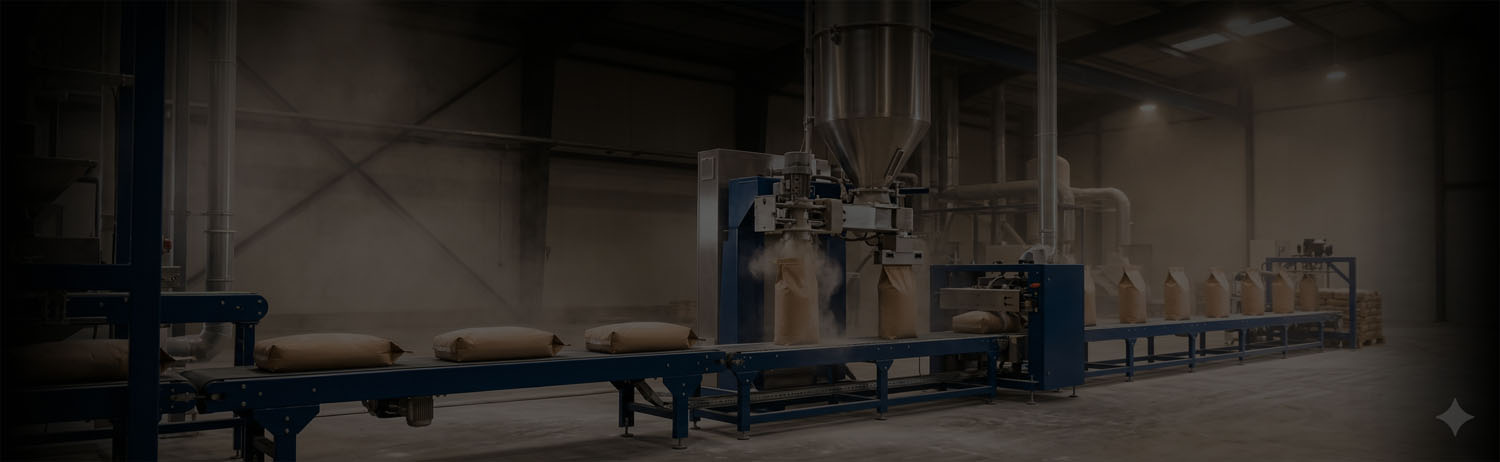
Flour Bagging Machine Types
Flour bagging system selection depends on flour fineness, bulk density stability, bag format, and ATEX area classification of your facility.
Automatic Net Weight Flour Bagger
Net Weight — Industrial Flour
The most-requested system from flour mills producing for food manufacturing, bakery wholesale, and export markets. Every bag is weighed individually by load cell — coarse flour flow to ~85% of target, fine flow to set-point, then cut-off. Bulk density variation between shifts or between flour grades has no effect on fill weight accuracy because the machine is measuring weight, not volume.
A flour mill in Turkey running this system on three shifts saw average bag weight compliance improve from 4.2% of bags failing internal weight check (±1% spec) to under 0.3% — not because of improved milling consistency but because the fill system stopped propagating density variation into weight errors. The calibration interval extended from every 2 hours (volumetric) to once per day (net weight).
- Bag weight:5 kg – 50 kg
- Speed:6–10 bags/min (single-spout)
- Accuracy:±0.3–0.6%
- Dust containment:Extraction hood standard
- ATEX:Zone 22 electrical available
Auger Flour Filling Machine
Auger Filler
Rotating screw metering for coarser flour grades (semolina, corn meal) with consistent bulk density. Suitable where flour moisture is controlled to within ±1% and only one flour grade is produced. Accuracy ±0.5–1.5% for consistent flour. Not recommended for mills producing multiple grades or packing freshly milled flour before conditioning.
- Fill range:500 g – 5 kg (small), or 5–25 kg
- Speed:Up to 40 fills/min (small packs)
- Accuracy:±0.5–1.5% (consistent product)
- Best for:Semolina, cornmeal, consistent grades
Retail Flour Packing Machine (1–5 kg)
Retail / Small Pack
VFFS (vertical form-fill-seal) or pre-made bag fill-seal for retail flour in 1 kg, 2 kg, and 5 kg printed bags. VFFS forms bags from roll-stock kraft-PE film with printing; pre-made bag systems handle retail paper flour bags. Speed: 20–60 packs per minute for VFFS. Food-grade stainless contact parts, CIP-compatible for allergen management between flour types.
- Pack weight:250 g – 5 kg
- Speed:20–60 packs/min (VFFS)
- Bags:Kraft-PE laminate, paper bags
- Best for:Retail, private label, specialty flour
Dual-Spout High-Speed Flour Bagger
Dual Spout
Two independent load cell spouts for flour mills targeting 12–16 bags per minute at 25 kg. Each spout has its own fill valve and dust extraction connection. Total system includes a dual-lane glue closer or tape closer (paper bags) or dual-needle stitcher (PP woven). Speed is validated with your flour before shipment.
- Bag weight:5 kg – 50 kg
- Speed:10–16 bags/min
- Spouts:2 independent (each load cell)
- Sealing:Dual glue closer or dual stitcher
Flour Bagger + Glue/Tape Closer
With Glue Closer
Integrated system for mills using multi-wall kraft paper bags (the dominant flour bag format in most food markets). Hot-melt glue closer applies adhesive to the top 2 folds of the paper bag and presses them together as the bag moves on the discharge conveyor. Produces a sealed bag with a cleaner appearance than stitching. CIP-compatible glue head for hygiene.
- Bag type:Multi-wall kraft paper (2–4 ply)
- Closure:Hot-melt glue or tape
- Line integration:Glue head on discharge conveyor
- CIP:Glue head cleanable
Semi-Automatic Flour Bagger
Semi-Automatic
Manual bag placement, foot-pedal trigger, gravity or auger fill. Suitable for small artisan mills, cooperatives, and test production. Capital cost $3,000–$7,000. For operations exceeding 2,000 bags per month or subject to weight regulation requiring per-bag records, the automatic net weight system is the correct choice.
- Bag weight:1 kg – 25 kg
- Speed:2–5 bags/min
- Accuracy:±1–3%
- Best for:Artisan mills, cooperatives
How a Net Weight Flour Bagging Line Works
1. Flour Feed — Conditioned Flour Preferred
Flour enters from a surge bin via a rotary valve feeder or screw conveyor. Freshly milled flour at 38–45°C has significantly lower bulk density than conditioned flour. Most high-accuracy flour lines include a conditioning silo (2–8 hours hold time) between the mill and the bagger. Without conditioning, even a net weight system sees higher in-flight variation due to flour aeration fluctuation.
2. De-Aeration Spear (Fine Flour)
For fine 00-grade and cake flour (bulk density below 520 g/L), a de-aeration spear vents displaced air from the bag as flour fills from the bottom. Without de-aeration, fine flour bags have excessive headspace and may not seal cleanly at the top. This step is not required for coarser semolina or cornmeal that packs naturally.
3. Net Weight Fill & Cut-Off
Coarse flow at full rate to ~85% of target. Fine flow at 10–15% rate to set-point. Load cell triggers cut-off. In-flight correction factor is calibrated for flour and is more variable than for denser products — we include a fine-flow calibration procedure in the commissioning checklist and recommend validating it at both the start and end of a shift for the first week of operation.
4. Bag Top Fold & Closure
Paper bag: top folder makes a 2–3 fold closure, hot-melt glue closer applies adhesive to the fold, hold rollers press the seal while glue sets (typically 3–5 seconds at normal conveyor speed). PP woven bag: top folder + stitcher. Glue closure quality is sensitive to conveyor speed and glue temperature — both are specified in the commissioning settings.
A flour mill in Turkey running net weight filling on 25 kg paper bags had a persistent problem with bags failing internal weight check at the start of morning shifts. Overnight, the mill floor dropped to 14°C. The flour in the conditioning silo at 14°C had bulk density around 610 g/L. By 10:00 AM as production warmed to 22°C, density dropped to 580 g/L. The in-flight correction factor was calibrated at warm conditions. The fix was a two-recipe PLC approach: a “cold start” recipe and a “steady state” recipe, with the operator switching at the 30-minute production mark. In the 6 weeks after implementing this, non-conforming bag rate dropped from 4.2% to under 0.3%.
Applications by Flour Type
Wheat Flour (All Grades)
From coarse semolina (200–400 µm) to fine 00-grade cake flour (below 90 µm). Each grade has different bulk density, flow characteristics, and bridging tendency. Auger filling is feasible for semolina; net weight with de-aeration is recommended for fine cake and bread flour grades where consistency matters at scale. For fill mechanism selection, dust control requirements and throughput benchmarks, see our flour packing machine guide.
Corn Flour & Cornmeal
Cornmeal (medium grind, 300–600 µm) fills well in auger systems — for whole kernel corn, cracked corn and corn meal on the same line, the fill mechanism selection is more involved; see our corn bagging machine application guide. Fine corn flour for tortilla and specialty markets has similar flow challenges to fine wheat flour — net weight filling for consistency. Yellow and white corn are handled on the same line with a product changeover and hopper purge.
Rice Flour & Starch
Rice flour is finer and denser than wheat flour (typical bulk density 800–900 g/L). It is also more abrasive — rice starch particles are harder than wheat starch. Harder contact materials (316L stainless with hardened auger flights) reduce maintenance intervals. Tapioca starch is extremely fine and hygroscopic — net weight with full hopper agitation.
Specialty & Alternative Flours
Chickpea flour, almond flour, oat flour, rye flour, and gluten-free products for food service and retail. Key specification: allergen management. Cross-contamination between wheat and gluten-free flour via residual dust in hoppers and conveyors is a serious food safety issue. CIP-compatible product paths and full allergen cleanout procedures are specified as standard for multi-allergen facilities.
Bread Mix & Premixes
Flour-based baking premixes containing sugar, salt, yeast, and additives. Variable bulk density depending on additive mix. Hygroscopic components (especially salt and certain emulsifiers) cause premix to cake in the hopper more readily than plain flour — active hopper agitation is typically required. Net weight filling handles the density variation from different batches.
Industrial Flour Supply
Large industrial flour users (biscuit factories, pasta manufacturers, bakery chains) often specify net weight filling as a supplier qualification requirement — they need per-batch traceability records with fill weights. Our net weight systems log every bag automatically. Weight records are exportable for customer audit or regulatory compliance.
Auger vs Net Weight for Flour: Real Numbers
| Factor | Auger Volumetric | Net Weight |
|---|---|---|
| Accuracy — single grade, controlled moisture | ±0.5–1.5% | ±0.3–0.6% |
| Accuracy — variable bulk density (±5% range) | ±5% or more (tracks density variation) | ±0.3–0.6% (density-independent) |
| Recalibration frequency (due to density shifts) | Every 1–2 hours in variable conditions | Once per day (load cell calibration) |
| Legal-for-trade compliance record | Not automatic | Per-bag weight log standard |
| Multi-grade changeover | Manual recalibration required | PLC recipe switch |
| Monthly overfill cost (1% overfill, 50,000 bags, $0.60/kg, 25 kg) | $7,500/month | $1,875/month (0.25% avg) |
| Capital cost (single-spout auto) | Lower ($8,000–$18,000) | Higher ($18,000–$32,000) |
| ROI payback on incremental cost | Baseline | Typically 6–12 months at these volumes |
Overfill cost baseline: 50,000 bags/month × 25 kg × $0.60/kg × overfill %. Payback based on overfill saving alone; calibration labour time saving adds a secondary return at mills with frequent density shifts.
Why Flour Mills Choose QingXin Machinery
Flour Flow Assessment Before Quoting
We ask for your flour’s bulk density range (not just the specification figure — the actual observed range in production), moisture content range, and conditioning time before we specify a fill system. A flour that behaves well at the lab moisture spec may bridge or aerate badly in your production environment. We have declined to quote auger systems for customers whose flour conditions would have produced unacceptable results — because a failed machine is worse for both parties than a correct recommendation upfront.
ATEX Specification for Flour Dust Zones
Wheat flour is St1 combustible dust (KSt ~80–120 bar·m/s). If your bagging area is classified Zone 21 or Zone 22 under ATEX, the fill head motor, control panel, and junction boxes must meet Category 2D or 3D respectively. This is a legal requirement in EU facilities, and many non-EU facilities follow the same standard. We ask for your ATEX area classification before specifying electrical components. ATEX-rated components add 10–20% to machine cost — not optional if the classification exists.
Per-Bag Weight Data for Customer Compliance
Industrial flour buyers (bakery chains, pasta factories, biscuit manufacturers) increasingly require weight traceability records from their flour suppliers. Our net weight systems log fill weight, timestamp, and fill station ID for every bag. Data exports in CSV format for your batch records or your customer’s quality management system. This is not an add-on — it is standard on every automatic net weight system we supply.
Glue Closer Calibration Included
Hot-melt glue closers are the most common source of sealed-bag failures on flour lines — glue not heating fully in cold start conditions, conveyor speed mismatch causing incomplete glue coverage, or glue head clogging after downtime. We include a glue closer calibration procedure in the commissioning documentation: glue temperature set-point, dwell time at each conveyor speed, and minimum closure bond strength test. Lines that skip this commissioning step typically call back within 3 months about bag sealing issues.
Technical Specifications
| Parameter | Semi-Auto | Auto Single-Spout | Auto Dual-Spout |
|---|---|---|---|
| Bag weight range | 500 g – 25 kg | 1 kg – 50 kg | 5 kg – 50 kg |
| Fill accuracy | ±1–3% | ±0.3–0.6% | ±0.3–0.6% |
| Speed (25 kg flour) | 2–4 bags/min | 6–10 bags/min | 10–16 bags/min |
| Fill principle | Gravity / auger | Net weight (load cell) | Net weight (dual load cell) |
| De-aeration | Not included | Spear optional (fine flour) | Spear standard (fine flour) |
| Bag types | Paper, PP woven | Kraft paper, PP woven, PE | Kraft paper, PP woven, PE |
| Sealing | Manual | Glue closer or stitcher | Dual glue closer or stitcher |
| ATEX version | Not available | Zone 22 (Cat 3D) option | Zone 22 (Cat 3D) option |
| Fill weight log | No | Per-bag CSV | Per-bag CSV (per spout) |
| Contact material | 304 SS / food-safe plastic | 304 SS, FDA/EU 1935 compliant | 304 SS, FDA/EU 1935 compliant |
| Power supply | 220V 50/60Hz | 380V 3-phase 50Hz | 380V 3-phase 50Hz |
| Lead time | 10–15 days | 18–25 days | 22–30 days |
Related Packaging Equipment
Grain Bagging Machine
Bagging systems for whole grains — wheat, corn, rice, soybeans — upstream of the milling process.
Powder Packing Machine
Broader powder packing category covering industrial powders with the same net weight and volumetric principles.
Automatic Bagging Machine
High-speed bagging for the full range of powders and free-flowing materials including flour.
Valve Bag Packing Machine
Valve bag filling for fine powders where a dust-tight sealed bag is required from fill.
Frequently Asked Questions
What types of flour can this machine pack?
Our flour bagging machines handle wheat flour (all grades), corn flour and cornmeal, rice flour, barley flour, rye flour, oat flour, and specialty flours including chickpea flour and tapioca starch. Fill system specification depends on flour fineness and moisture content. We ask for flour granulometry, bulk density, and moisture content before specifying the fill system.
What is the filling accuracy for a flour bagging machine?
Net weight systems achieve ±0.3–0.8% at production scale for flour. Auger volumetric fillers achieve ±0.5–1.5% for flour with consistent bulk density, and ±1.5–3% for flour with moisture variation. The critical issue is that flour bulk density varies with moisture — a 1% increase in moisture changes flour bulk density by 2–4%. Net weight filling compensates automatically; auger volumetric filling does not.
What bag types are used for flour?
Multi-wall kraft paper bags (2–3 ply) are standard for most commercial flour markets — breathable, printable, and compostable. PP woven sacks are preferred where moisture resistance takes priority. Retail flour (1–5 kg) uses printed kraft-PE laminate or paper bags. Sealing method differs: paper bags use hot-melt glue or tape; PP woven uses stitching; retail packs use heat sealing.
How do I prevent flour bridging in the hopper?
Fine wheat flour bridges in hoppers when moisture exceeds ~14.5% or hopper angle is below 60–65°. Solutions: active hopper agitation (vibrating sidewalls or paddle), steep-cone hopper design (70°+), and aerated bin discharger for difficult-flowing grades. Freshly milled flour (35–45°C) behaves differently from conditioned flour. We ask for flour condition at point of bagging — not just the lab analysis.
What dust containment is required for flour bagging?
Wheat flour dust (below 850 µm) is combustible — St1 class. This requires ATEX Zone 22 classification and Cat 3D electrical equipment in the fill zone. Most flour mills have ventilation and extraction around the fill station. We ask for your facility’s ATEX area classification before specifying electrical components. ATEX-rated components add 10–20% to base machine cost.
How fast can a flour bagging machine fill bags?
Automatic net weight single-spout for 25 kg flour bags: 6–10 bags per minute. Dual-spout: 10–16 bags per minute. Fine flour (00-grade) runs 30–40% slower than coarse semolina on the same equipment. We validate fill speed with a product sample before shipment and tell you the expected rate for your specific flour before you order.
What is the price of a flour bagging machine?
Semi-automatic auger fillers for small mills: $3,000–$8,000. Automatic net weight single-spout with dust extraction: $18,000–$32,000. Dual-spout with glue closer and conveyor: $32,000–$55,000. High-speed systems with ATEX electrical components: $60,000–$100,000+. ATEX-rated electrical components add 10–20% — not optional if your facility has a Zone 21 or Zone 22 classification.
What Buyers Say After 12 Months on the Line
Real feedback from three production environments — grain, chemical powder, and cement.
We had specified a machine from another supplier based on a PDF quotation. QingXin’s engineer came back and said the auger pitch wasn’t right for our product bulk density and suggested a different filling head. That kind of pushback was unexpected — and correct.
The chemical powder we pack has variable bulk density depending on batch temperature. I was told by two other suppliers this was ‘not a problem’ without testing. QingXin ran a sample test and recommended a different hopper agitator. 18 months in, the machine has not had a single blockage.
We run the cement packer on two shifts, six days a week. The hardened impeller wear liners lasted 14 months before first replacement — the previous machine needed replacement every 4 months. Maintenance cost in year one was 60% lower than the machine we replaced.
Further Reading
Request a Factory Direct Quote
CE-certified machines, factory pricing, 48-hour quote turnaround.