
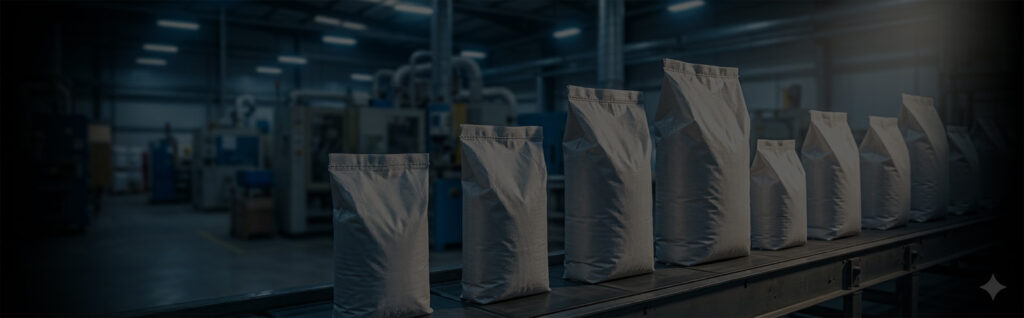
Our Products
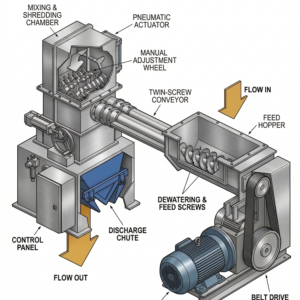
Bagging Machine
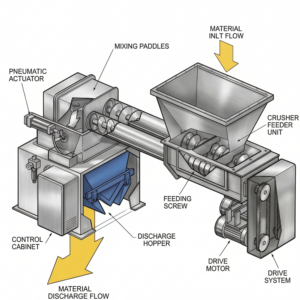
Bagging Machine
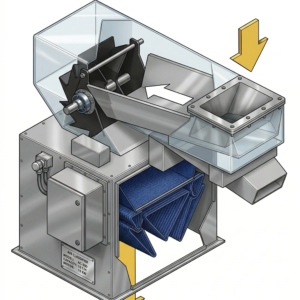
Bagging Machine
Powder Packing Machine Types
Fill principle selection is driven by powder flow classification. Getting this wrong produces consistent fill-weight problems regardless of how well the machine is maintained or calibrated.
Net Weight Powder Packing Machine
Net Weight / Gravimetric
The most-asked-about machine in our range, and for good reason — it is the only system that handles bulk density variation without operator intervention. Every bag is weighed individually: the fill starts fast (coarse flow), slows to a trickle when approaching the set-point (fine flow), and cuts off when the load cell reads the exact target weight. Tare correction for bag weight variation is automatic.
At 25 kg bags with a 500 g/L bulk density product, we see ±0.3–0.5% accuracy in sustained production. That translates to less than 75 g per bag, well inside most regulatory tolerances. For products with ±10% batch-to-batch bulk density variation — which is common in agricultural powders and recycled materials — this is the only fill system that delivers consistent weight without constant recalibration.
- Bag weight range:1 kg – 50 kg
- Speed:4–14 bags/min (product-dependent)
- Accuracy:±0.3–0.8% at production scale
- Fill principle:Dual-speed: coarse + fine flow
- Bag types:Open-mouth PP, PE, paper, FFS
Auger Powder Filling Machine
Auger Filler
Rotating screw metering for free-flowing and moderately cohesive powders. Reliable and cost-effective for products with consistent bulk density: spices, flour, dried milk, fine chemicals, cement (dry blends). Accuracy is typically ±0.5–1.5% for small fills (100 g – 1 kg) and ±1–2% for larger weights where screw variation accumulates.
- Fill range:50 g – 5 kg per cycle
- Speed:Up to 60 fills/min (small containers)
- Accuracy:±0.5–1.5%
- Best for:Free-flowing powders, consistent bulk density
Impeller Powder Packing Machine
Impeller / Rotary Valve
For cohesive and poorly-flowing powders (talc, carbon black, titanium dioxide, fumed silica) that bridge in an auger, the impeller filler uses a spinning rotor to force product into the bag against the pack pressure. Consistent fill weight depends on constant head pressure above the impeller — hopper level management is critical for this type.
- Fill range:5 kg – 50 kg
- Speed:3–8 bags/min
- Accuracy:±1–2%
- Best for:Cohesive and aerated powders
Open-Mouth Bag Filling Machine
Open-Mouth Bag Filler
Dedicated system for PP woven, multi-wall paper, and PE open-mouth sacks from 5 to 50 kg. Bag is presented open on a fill spout, fills under gravity or net weight, then passes to a sealer. Integrated bag clamp and de-aeration spear improve fill density. Most 25 kg industrial product bags in chemical, mineral, and agricultural markets use this format.
- Bag weight:5 kg – 50 kg
- Speed:Up to 600 bags/hr
- Sealing:Stitching or heat seal integration
- Bag types:PP woven, paper, PE, laminated
Valve Bag Powder Packing Machine
Valve Bag Filler
For cement, lime, gypsum, and other fine mineral powders packed into valve bags where the fill spout inserts into a sleeve valve that closes under bag pressure. Impeller-type rotary packers achieve 600–800 bags/hr. Dust containment at the spout is essential — improperly sealed valve bags are the primary dust source in cement packing operations.
- Bag weight:20 kg – 50 kg
- Speed:Up to 800 bags/hr (6-spout)
- Accuracy:±1–1.5%
- Best for:Cement, lime, dry mortar, mineral powders
Form-Fill-Seal Powder Packer
FFS / Form-Fill-Seal
Vertical FFS machines form bags from roll stock film and fill in-line — suited for small retail packs (100 g to 5 kg) where bag cost and fill rate both matter. Auger metering for free-flowing powders; vibratory metering for granules. Output can reach 80–120 bags/min for small pack sizes, but FFS machines require more maintenance than open-mouth fillers.
- Pack weight:50 g – 5 kg
- Speed:20–120 bags/min
- Film:PE, laminate, kraft-PE
- Best for:Retail packs, food powders, chemicals
How a Net Weight Powder Packing Machine Works
Net weight filling is the most reliable system for products with variable bulk density. Here is what happens inside each fill cycle.
1. Bag Presentation & Tare
The empty bag is presented on the fill spout (automatic or manual). The load cell under the bag reads the empty bag weight, sets the tare, and calculates the target gross weight. Bag weight variation of ±10 g is handled automatically — the fill target adjusts per bag, not per shift.
2. Coarse Flow Fill
Product flows at full rate until approximately 80–90% of target weight is reached. Fill rate at this stage is optimised for speed — the bottleneck on most powder lines is not the fill speed itself, but the time to transition from coarse to fine flow without overshoot.
3. Fine Flow & Cut-Off
At 90% of target, flow rate drops to 10–20% of coarse speed. The load cell monitors weight continuously and triggers the cut-off valve when the net weight target is reached. PLC correction factors account for product in flight between cut-off and final weight reading.
4. Discharge & Seal
The filled bag is released from the spout onto a discharge conveyor and passes through a bag flattener (de-aeration) before sealing. A checkweigher downstream confirms net weight before sealing — out-of-tolerance bags are diverted to rework, not sealed and shipped.
The most consistent accuracy problem on net weight powder lines is “in-flight error” — product that has left the hopper but has not yet settled into the bag when the load cell triggers cut-off. On dense, fast-flowing products (900 g/L bulk density) the in-flight weight can be 150–300 g. PLC correction factors compensate for this, but they need recalibration when you switch products or when ambient temperature changes significantly affect product flow. We configure correction factor recalibration as a scheduled maintenance step (every product changeover) and document it in the operating manual. Lines that skip this step accumulate drift over weeks.
Industry Applications
Powder packing requirements vary significantly by industry — not just in bag weight and speed, but in regulatory requirements, dust classification, and material compatibility.
Chemical & Industrial Powders
Pigments, detergent powders, zeolite, silica, sodium carbonate, and technical minerals. Dust containment specification varies widely by OEL classification — some products require simple extraction hoods; others need full contained filling with local exhaust ventilation. We ask for the product SDS (safety data sheet) before specifying a containment level.
Food Powders & Spices
Flour, sugar, salt, dried milk, protein powder, spices, and seasonings. Food-grade contact materials (304 SS, food-safe plastics) and CIP-compatible product paths. For sticky or hygroscopic products, temperature-controlled fill environments and nitrogen purge options are available to prevent bridging and caking during filling.
Construction Materials
Cement, gypsum, dry mix mortar, tile adhesive, and lime. Valve bag packing is standard for cement and gypsum — impeller rotary packers at 600–800 bags/hr. Wear-resistant contact parts (manganese steel, hardened liners) are specified as standard for abrasive mineral products with Mohs hardness above 4.
Pharmaceutical & Fine Chemicals
GMP-compliant powder filling for API intermediates, excipients, and finished pharmaceutical products. High-containment filling (OEL below 10 µg/m³) requires isolator or glove-box configuration. 316L stainless, Ra ≤0.8 µm surface finish, full audit documentation. ATEX classification for solvent-associated powders. For full GMP requirements, fill mechanism selection and IQ/OQ/PQ validation guidance, see our pharmaceutical powder filling machine guide.
Agricultural & Fertilizers
Granular and powdered fertilizers, pesticide WP (wettable powder) formulations, seed treatments, and soil amendments. Fill weight accuracy matters at scale — a 1% overfill on a $0.80/kg fertilizer product costs $800 per 100,000 bags. Corrosion-resistant contact materials for ammonium nitrate and acidic formulations.
Pet Food & Animal Nutrition
Powdered milk replacers, vitamin premixes, protein supplements, and medicated feed powders. FDA/EU-compliant materials and cleanability are the key specifications. Products that contain fats or oils have specific temperature sensitivity requirements during filling — fat-coated powders cake above 28–30°C ambient.
Fill Principle Comparison
Here is what the three main fill principles actually deliver in sustained production across the parameters that matter for your cost model.
| Parameter | Auger (Volumetric) | Impeller (Volumetric) | Net Weight (Gravimetric) |
|---|---|---|---|
| Accuracy at production scale | ±0.5–1.5% | ±1–2% | ±0.3–0.8% |
| Bulk density variation compensation | None — requires manual recalibration | None — requires manual recalibration | Automatic per-bag correction |
| Suitable powder flow class | Free-flowing and moderate cohesion | Poor-flowing and aerated | All classes with correct feed system |
| Speed (25 kg bags) | 6–10 bags/min | 4–8 bags/min | 4–14 bags/min |
| Monthly overfill cost at 50,000 bags (25 kg, $0.80/kg) | $12,000–$24,000 (1.2% avg overfill) | $20,000–$40,000 (2% avg overfill) | $3,000–$8,000 (0.3–0.8% avg) |
| Maintenance (moving parts in product path) | Auger wear, seal replacement | Impeller wear, liner replacement | Load cell calibration, cut-off valve |
| Capital cost (single-spout auto) | Lowest ($8,000–$18,000) | Medium ($12,000–$25,000) | Higher ($18,000–$35,000) |
| ROI vs overfill cost at 50,000 bags/month | Baseline | Worse than auger | Payback typically under 8 months |
Overfill cost baseline: 50,000 bags/month × 25 kg × $0.80/kg product value. Adjust proportionally for your bag weight and product value. Net weight payback calculation excludes capital cost of checkweigher if already on line.
Why Buyers Choose QingXin Machinery
Powder Flow Classification Before Quoting
We ask for your product’s Carr Index or angle of repose before specifying a fill system — not because it is on a checklist, but because we have seen buyers receive auger fillers for titanium dioxide (which air-entrains and bridges in an auger) and spend months trying to make it work. Fill principle selection takes 10 minutes if the right information is provided upfront. It takes 6 months and significant cost if it is discovered after delivery.
Pre-Shipment Accuracy Validation
Every net weight system ships with a 30-bag accuracy test report, signed by our QC team. The report includes mean fill weight, standard deviation, min/max, and the fill principle settings used. This is the baseline you use to confirm the machine is performing correctly on installation. If your line shows worse accuracy than the report, the problem is in commissioning, not the machine — and we will help you find it remotely.
Dust Containment Specified to Your OEL
We do not default everyone to the same extraction hood spec. Before we design the containment system, we review your product SDS, the OEL or WEL for the active ingredient, and your local regulatory requirements. The difference between a standard extraction hood and a full contained fill station is $15,000–$40,000. Getting the specification right means not under-spending on a hazardous product or over-spending on benign mineral powder.
Factory-Direct Pricing With Full Documentation
We are the manufacturer. No distributor is adding 20–35% to the price between our factory and your purchasing department. The technical file, CE Declaration of Conformity, and risk assessment that come with every machine are our documents — not a third party’s paperwork that arrived with the machine and nobody at the distributor can interpret. Buyers who have had CE issues at customs or with their health-and-safety auditors understand why this matters.
Technical Specifications
| Parameter | Auger Filler (Auto) | Net Weight Filler (Single) | Net Weight Filler (Dual Spout) |
|---|---|---|---|
| Fill weight range | 50 g – 5 kg | 1 kg – 50 kg | 5 kg – 50 kg |
| Fill accuracy | ±0.5–1.5% | ±0.3–0.8% | ±0.3–0.8% |
| Speed | 10–60 fills/min | 4–10 bags/min | 8–18 bags/min |
| Bulk density range | 300–1200 g/L | 150–1500 g/L | 150–1500 g/L |
| Bag types | Pouches, jars, boxes | Open-mouth PP/paper/PE | Open-mouth PP/paper/PE |
| Contact material | 304 SS / food-grade plastic | 304 SS standard, 316L option | 304 SS standard, 316L option |
| Dust extraction | Hood standard | Hood standard, full containment option | Hood standard, full containment option |
| PLC control | Delta / Siemens | Delta / Siemens + load cell controller | Delta / Siemens + dual load cell |
| ATEX version | Available on request | Available on request | Available on request |
| Power supply | 220V / 380V 50Hz | 380V 3-phase 50Hz | 380V 3-phase 50Hz |
| Lead time | 12–18 days | 18–25 days | 22–30 days |
| Warranty | 12 months | 12 months | 12 months |
Related Packaging Equipment
Automatic Bagging Machine
High-speed bagging for free-flowing powders, granules, and pellets. Net weight systems with integrated bag handling.
Packing Scale
Standalone gravimetric packing scales for industrial powders and bulk materials. Same net weight principle in a standalone format.
Cement Bagging Machine
Specialised valve bag packers for cement, gypsum, and fine mineral powders. Impeller type for high-speed abrasive product filling.
Automatic Packaging Line
Complete powder packing lines integrating filling, sealing, checkweighing, and palletising into a single turnkey system.
Frequently Asked Questions
What is the difference between auger and impeller powder filling?
Auger fillers use a rotating screw to meter a controlled volume of powder into each container. They work well for free-flowing and moderately cohesive powders (flour, spices, fine chemicals) with consistent bulk density. Impeller (rotary) fillers use a spinning impeller to force powder through an orifice — they handle poor-flowing and aerated powders (talc, carbon black, fumed silica) that an auger would bridge or pack inconsistently. Choosing the wrong principle is the most common source of fill weight inconsistency. If you tell us your powder’s bulk density, particle size, and flow classification, we can recommend the right filling principle without guessing.
How accurate is a powder packing machine?
Auger fillers typically achieve ±0.5–1.5% at production scale for free-flowing powders. Impeller fillers for poor-flowing powders are typically ±1–2%. Gravimetric (net weight) fillers check every bag individually against a set-point using load cells and achieve ±0.3–0.8% regardless of bulk density variation. The published accuracy on spec sheets is almost always achieved under ideal conditions — uniform bulk density, stable vibration environment, calibrated auger. In real production with variable raw material batches, the practical range is 30–50% worse than spec. We run 30-bag accuracy validation tests before shipment and provide signed results.
What bag types does the machine work with?
The main distinction is open-mouth bags vs valve bags. Open-mouth bags (PP woven, kraft, PE, multi-wall paper) are filled through an open top, then sealed by stitching, heat sealing, or gluing. Valve bags (cement bags, chemical bags) are filled through a spout valve that seals itself under the pressure of the filled powder. Valve bag fillers use an impeller or rotary packer specifically designed to pressurize the product into the sealed bag. Most of our powder packing machines are specified for one bag type — confirm your packaging format at enquiry stage. We also call this an powder bagging machine in some configurations.
How much does a powder packing machine cost?
Semi-automatic single-head auger fillers start around $1,500–$4,000. Automatic single-spout open-mouth bag fillers run $8,000–$20,000. Automatic net weight systems with checkweigher and bag clamp start at $18,000–$35,000. High-speed rotary valve bag packers (6–8 spout) for cement or chemical powders range from $45,000–$120,000 depending on capacity and dust containment specification. The biggest cost driver beyond the base machine is dust extraction and containment for hazardous or pharmaceutical powders — this can add 20–40% to system cost.
How do I maintain consistent bag weights when bulk density varies batch to batch?
Volumetric filling (auger or impeller) cannot compensate for bulk density variation — if density drops 5%, fill weight drops 5%. The only reliable solution is net weight filling: a load cell under the bag measures actual weight and stops the fill when the target is reached. On automatic net weight systems, the gross-to-net correction (bag tare) is handled automatically. For products with known bulk density variation of more than ±3% batch to batch, we recommend net weight filling from the outset. Retrofitting a checkweigher downstream catches the problem but doesn’t fix it — underfilled bags still go to rework.
What filling speed should I expect?
Semi-automatic: 3–6 bags per minute (operator-dependent). Automatic single-spout open-mouth: 4–10 bags per minute. Automatic dual-spout: 8–18 bags per minute. Rotary valve bag packer (6-spout): up to 600–800 bags per hour depending on bag weight and powder flow rate. Speed figures in supplier brochures are usually for standard free-flowing products at the minimum bag weight. With cohesive products or large bags (25–50 kg), expect 20–40% lower throughput than published figures.
What dust containment is available?
For standard powders, an integrated dust extraction hood at the fill spout reduces ambient dust to acceptable occupational exposure levels. For pharmaceutical ingredients, fine chemicals, and materials classified as hazardous (REACH/CLP), full containment filling requires a glove-box or isolator configuration around the fill station. ATEX-rated motors and electrical panels are required for explosive dust classifications (dust groups St1, St2, St3). Containment specification must be confirmed before build — it cannot be retrofitted cost-effectively. We ask for your product’s dust classification and exposure limit (OEL) as part of the technical review.
What Buyers Say After 12 Months on the Line
Real feedback from three production environments — grain, chemical powder, and cement.
We had specified a machine from another supplier based on a PDF quotation. QingXin’s engineer came back and said the auger pitch wasn’t right for our product bulk density and suggested a different filling head. That kind of pushback was unexpected — and correct.
The chemical powder we pack has variable bulk density depending on batch temperature. I was told by two other suppliers this was ‘not a problem’ without testing. QingXin ran a sample test and recommended a different hopper agitator. 18 months in, the machine has not had a single blockage.
We run the cement packer on two shifts, six days a week. The hardened impeller wear liners lasted 14 months before first replacement — the previous machine needed replacement every 4 months. Maintenance cost in year one was 60% lower than the machine we replaced.
Further Reading
Request a Factory Direct Quote
CE-certified machines, factory pricing, 48-hour quote turnaround.